

6 Best ABA Mental Health Treatment Plan Software in 2026


For Applied Behavior Analysis (ABA) practices, treatment plan software needs to link clinical documentation, progress tracking, and reauthorizations. Without that connection, gaps in documentation can slow down care and put revenue at risk. Here are six platforms to compare before you make a decision.
6 best mental health treatment plan software options: Quick comparison
How we evaluated these platforms
We compared each platform based on criteria that reflect how ABA treatment planning actually works. Our criteria included:
- Treatment plan depth: Can Board Certified Behavior Analysts (BCBAs) create, individualize, and update plans with the flexibility that clinical work requires?
- Data collection and progress tracking: Does session data feed directly into treatment reports and graphs, or does someone have to reenter it manually?
- Use value for the whole team: How easy is it for Registered Behavior Technicians (RBTs), BCBAs, and admin staff to learn and use the software daily?
- Billing and authorization connections: Does clinical documentation connect to billing records, or are these systems separate?
- User feedback: How closely does real-world performance match what each platform claims?
These factors helped us identify which platforms genuinely support a growing practice's needs when it comes to treatment planning.
1. Passage Health: Best mental health treatment plan software for ABA practices
What it does: Connects treatment planning, clinical documentation, scheduling, supervision tracking, and billing in one platform designed specifically for ABA therapy providers.
Best for: ABA and autism therapy practices that need their clinical and billing workflows to work together, not independently.
What separates Passage Health from general EHR platforms is its starting point. Most systems were built for medicine first and adjusted for behavioral health later. Passage Health was designed specifically for ABA workflows, which means treatment planning, session documentation, credential management, and billing all share the same data from the beginning.
Key features
- Mobile app data collection: RBTs log session data in real time, with automatic syncing to the central record as soon as the session ends.
- Client intake management: Collect and track potential clients in a streamlined pipeline, without spreadsheets or external tools.
- Customizable treatment reports and graphing: Progress data is pulled into visual reports automatically, making reauthorization submissions faster to prepare.
- Scheduling: Manage appointments, reassign staff, and view your full team calendar with color-coded availability across your practice.
- Automated billing coding rules: Configure payor-specific rules once, and the system applies the correct codes across all relevant session types.
- Reporting and insights: Monitor utilization and practice performance from a single dashboard. There’s no exporting data between separate tools.
- Frontera AI integration: Bring clinical AI features into your ABA workflows, including support for treatment planning and session documentation.
- Easy to learn across all roles: New RBTs and BCBAs can get up to speed quickly, and a quarterly release cycle keeps the platform current, without disruptive system overhauls.
Pros
✅ It’s built specifically for ABA therapy, not adapted.
✅ Treatment planning and billing stay connected, reducing claim errors.
✅ Built-in supervision tracking means there’s no need for additional spreadsheets.
✅ Automated coding rules reduce manual work and billing errors.
✅ Progress reports are ready for insurance reauthorizations.
Cons
❌ It’s not designed for hospitals, surgical settings, or non-ABA disciplines.
❌ Pricing is custom, there are no published tiers online.
What users say
“Running a session has never been so easy. My team is loving the app and the real-time data syncing. Being able to enter data, see it saved instantly, edit the note at the same time, and have a supervisor seeing this happen live on their own device is amazing.” – Nicole Edge, Autism Services of Florida
“With Passage we are able to move more efficiently, it is a game changer. The system is seamless. The onboarding experience was amazing and ongoing support is really proactive.” – Liza Ozowara, Executive Director, Agape
Pricing
Custom pricing based on practice size and needs.
Bottom line
Passage Health is purpose-built for ABA, which makes it the most practical choice for practices that need to build and manage treatment plans, bill insurance, track supervision, and keep clinical data connected in one place.
2. Motivity: Best for practices prioritizing clinical data depth
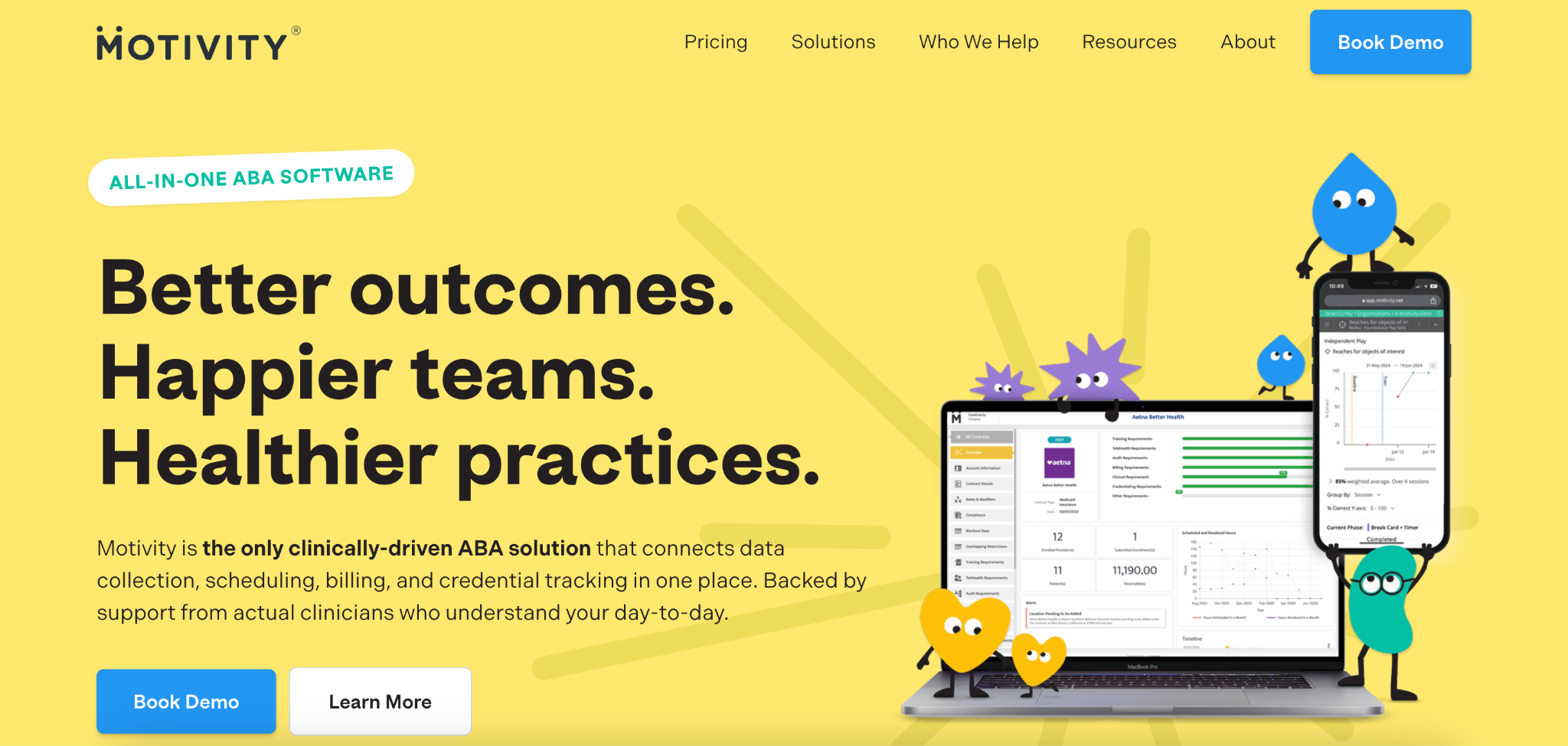
What it does: Motivity is a clinical documentation and data collection platform built for ABA providers. It covers treatment planning, session data collection, progress visualization, and practice management.
Best for: ABA practices where BCBAs need deep control over program design, data input types, and mastery criteria.
Motivity's program builder stands out for its extensive customization features, and the real-time charting is useful for supervisors who need to act on data quickly.
With that said, getting the platform configured to your workflows takes significant time up front, so plan for that investment before you commit.
Key features
- Customizable program builder: BCBAs control teaching instructions, data inputs, and mastery criteria for each program.
- Live charting: Progress graphs update in real time as session data is collected.
- Multiple data collection types: Programs can suit frequency, duration, interval, and many other recording methods.
- Authorization tracking and credentialing tools: The platform manages insurance authorizations and staff credentials.
Pros
✅ Flexible clinical tools that match how BCBAs work
✅ Real-time data visibility for supervisors
✅ Responsive support team with training resources
Cons
❌ The initial setup requires significant time to configure.
❌ The advanced program builder features take time to master.
❌ The practice management and billing features are less developed than the clinical tools.
What users say
“Good UI, easy to use and very friendly for english speaking users.” – Verified User, G2 Review
“It is very hard to know how to get everything set up right so that it will work correctly or the way you want it to. The system is very complex and you have to take classes to make it do right.” – Ashley C., Senior Loan Officer, G2 Review
Pricing
- Data Collection or Practice Management: $24/learner/month
- All-in-One platform: $48/learner/month
- Scheduling add-on: +$9/learner/month
Bottom line
Motivity is a good choice for practices that need a lot of clinical program customization and real-time data visibility. However, there’s a significant onboarding time commitment, and practices that need tightly connected billing, operations, and clinical tools will likely find gaps.
3. Hi Rasmus: Best for strong BCBA oversight
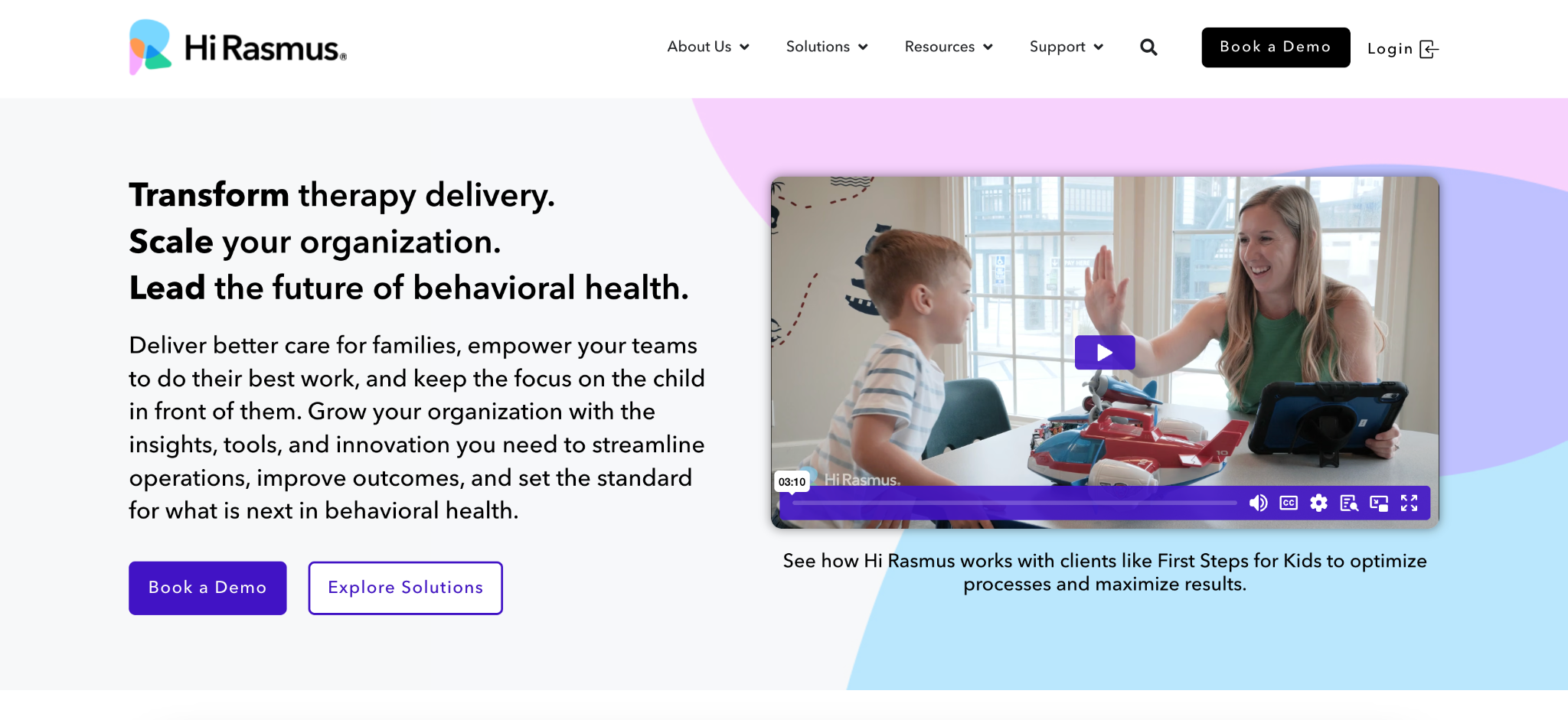
What it does: Hi Rasmus is a clinical ABA platform focused on treatment planning, data collection, scheduling, and BCBA supervision. It integrates with practice management tools like AlohaABA and TherapyPM for billing and operations.
Best for: ABA practices where clinical quality and BCBA oversight are the primary concern.
Hi Rasmus is clearly built with the clinician in mind. The interface feels intuitive for RBTs running sessions, and BCBAs can program new targets and complete supervision documentation without switching between screens. The catch is that billing and practice management require separate, integrated systems, so you're always running more than one system at a time.
Key features
- Individualized program libraries: Build and assign programs at the learner level from a customizable curriculum.
- AI-powered session notes: Reduce supervisor documentation time with automated note generation.
- Supervise Mode: Run multiple staff competency sessions and reviews simultaneously.
- Credential tracking: Monitor staff certifications and compliance within the platform.
Pros
✅ Clinical tools built around how BCBAs supervise and program
✅ Intuitive interface for RBTs during sessions
✅ Implementation support from the Hi Rasmus team
Cons
❌ It relies on third parties for billing and operations.
❌ Integration with some practice management systems has been inconsistent.
❌ Pricing is only available on request.
What users say
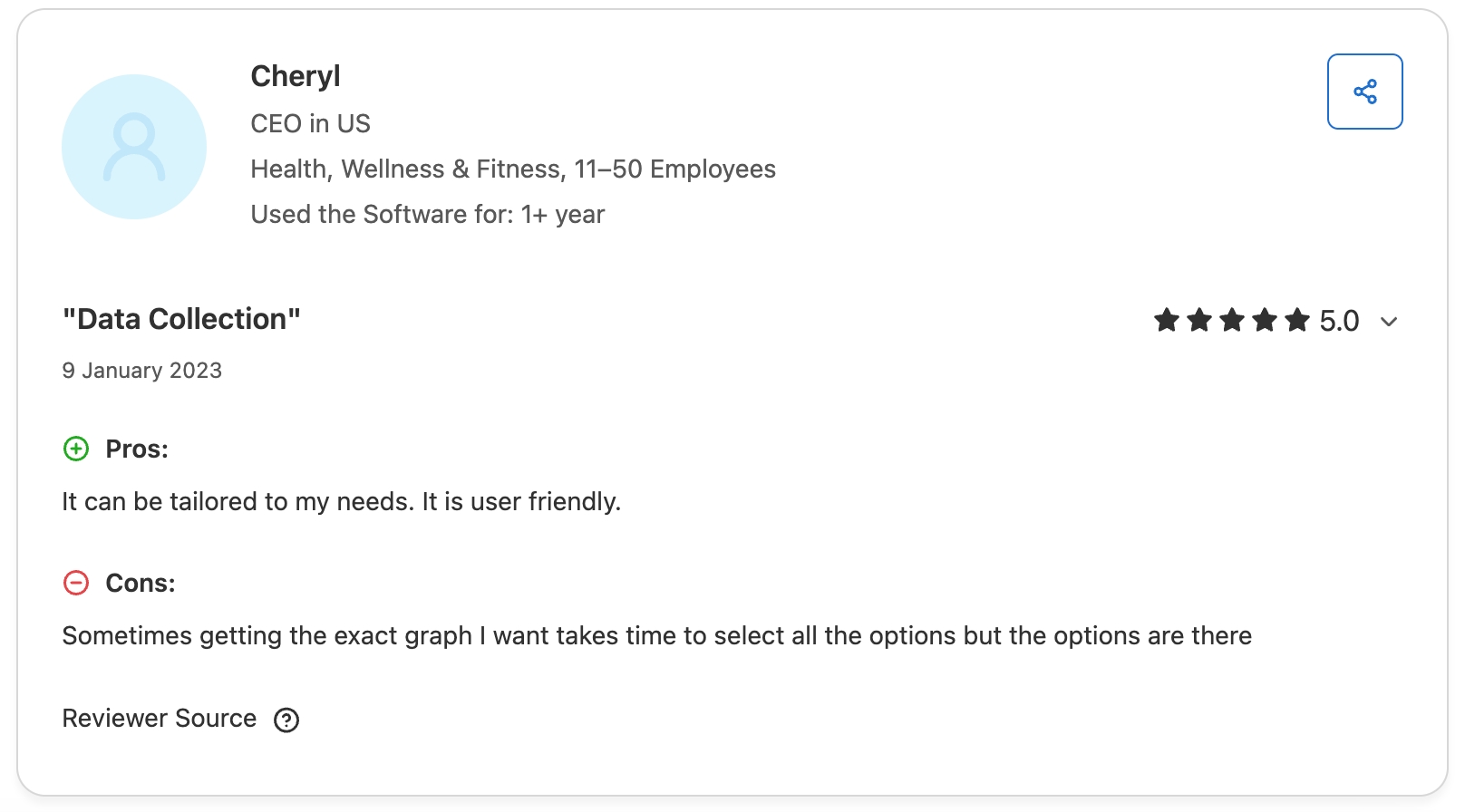
"It can be tailored to my needs. It is user friendly." – Cheryl, CEO, Capterra Review
"There were frequent issues with programs not fading prompts. Task analyses were difficult to set up. The interface with Aloha was less than ideal, with frequent issues." – Devann, BCBA, Capterra Review
Pricing
Custom quote.
Bottom line
Hi Rasmus works well for practices where BCBA oversight and clinical customization come first. If your operations already run through TherapyPM, the integration seems to hold up. But if you want billing and clinical tools linked in the same system, you'll need to look elsewhere.
4. RethinkBH: Best for multidisciplinary practices and staff training
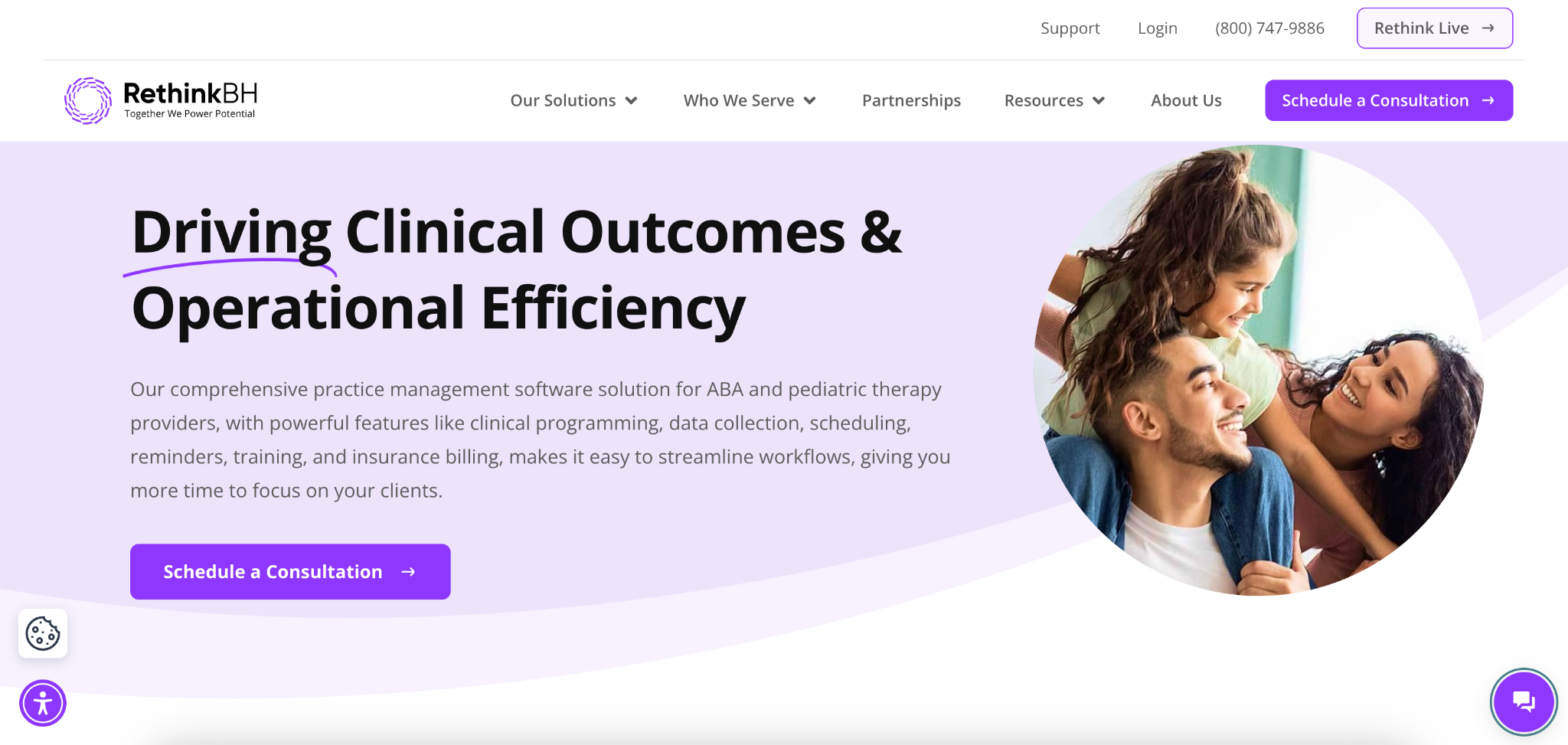
What it does: RethinkBH is an ABA practice management platform combining clinical programming, data collection, staff training, scheduling, and billing in one modular platform.
Best for: Growing ABA and multidisciplinary practices that want clinical tools and staff training resources in the same place.
RethinkBH covers a lot of ground, and the built-in RBT training library is its most distinctive feature. The clinical and training tools work well for single-service ABA practices. However, some users report limitations as their practices grow or add services.
The module-based structure also makes the total cost difficult to assess before you get on a call with the sales team.
Key features
- Care plan library: BCBAs can adapt over 1,500 programs for individual learners.
- Video-based staff training: Access a built-in curriculum aligned with Behavior Analyst Certification Board requirements, covering RBT certification and ongoing development.
- Scheduling with EVV support: The appointment management feature has electronic visit verification built in for compliance.
- Flexible billing options: Manage it internally or hand it off to RethinkBH's billing team.
- Clinical and operational dashboard: Track learner progress, staff utilization, and practice performance in one view.
- Medical necessity documentation: This supports the clinical justification process required for insurance authorization.
Pros
✅ The large content library reduces setup time when you’re running common ABA programs.
✅ Staff training sits alongside clinical tools.
✅ Suitable for ABA, speech, occupational, and physical therapy workflows.
Cons
❌ Multiple users report system performance issues during data entry.
❌ Support response times are a consistent complaint across review platforms.
❌ Modular pricing makes the total cost hard to gauge up front.
What users say
"Very useful and easy to learn how to use." – Jobe, RBT, Capterra Review
"Overall, Rethink worked when we were a small, ABA-only organization. As we grew and started to provide different services and different service lines, it did not work. Even worse, when we went to leave Rethink, they stopped responding. The customer service is deplorable." – Jen G., Director, Capterra Review
Pricing
Custom quote based on practice size and module selection.
Bottom line
RethinkBH suits practices that need a broad clinical and training toolkit and don’t want to piece together separate systems. Still, the support complaints and performance issues reported by users are worth considering.
5. AlohaABA: Best for scheduling and billing, plus clinical tools
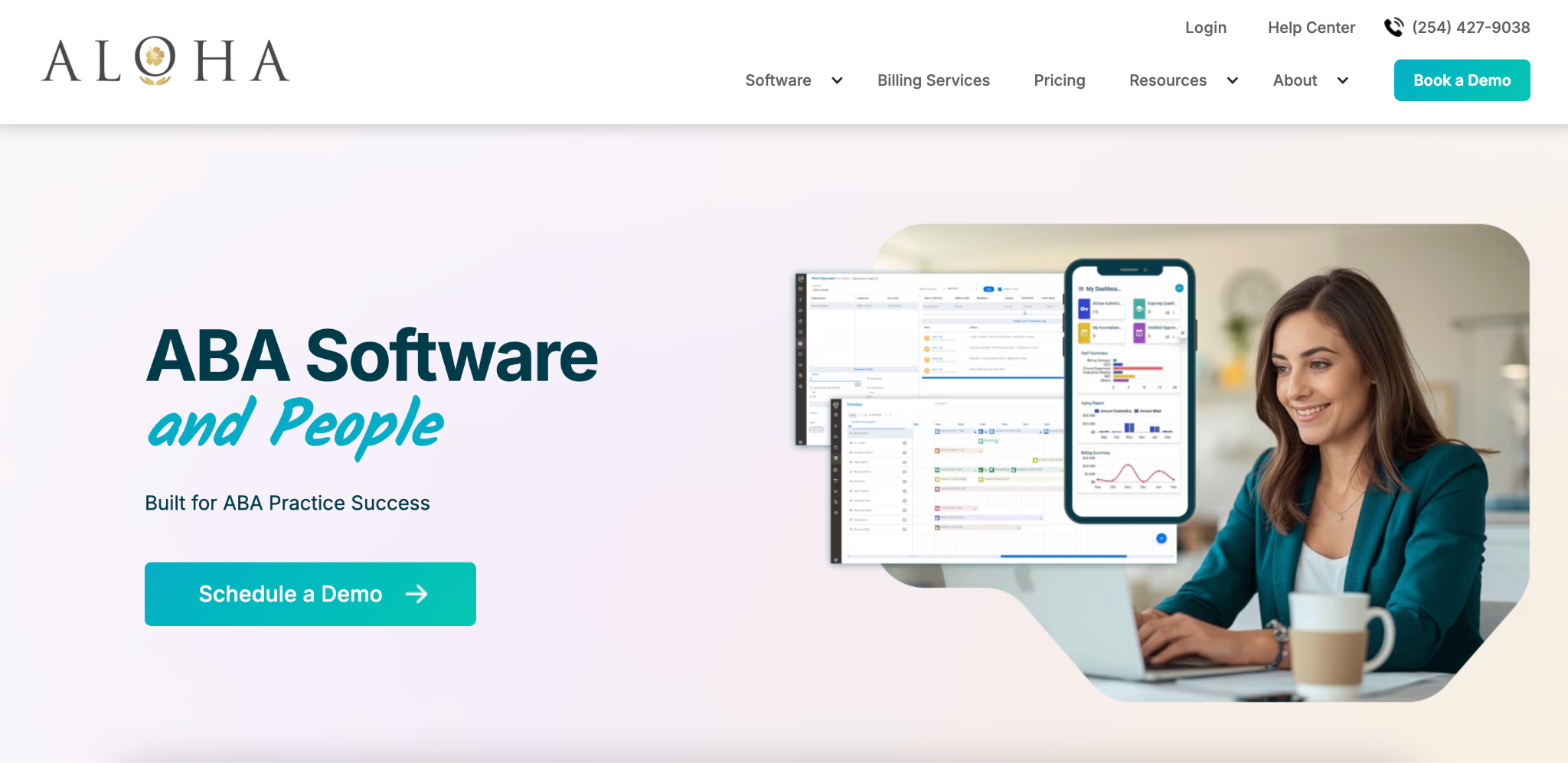
What it does: AlohaABA is a platform with two main packages: practice management, which includes scheduling, billing, payroll, and claims, and data collection, which covers documentation management.
Best for: ABA practices that want scheduling, billing, and operational management alongside documentation.
AlohaABA's data collection package offers customizable templates, prompts, and mastery criteria, as well as real-time data syncing and automatic progress visualization.
However, data collection is only available alongside the practice management package. And users report that the clinical documentation tools are functional but noticeably less flexible than those of dedicated clinical platforms.
Key features
- Integrated scheduling and billing: Session bookings connect to claims and payroll, reducing manual data transfer between systems.
- Authorization management: Authorization balances and usage are tracked for each learner, with alerts as limits approach.
- Visual analytics dashboard: Key metrics, including billing status, session volume, and staff productivity, are monitored.
- Treatment documentation and customizable forms: The platform stores session notes, treatment plans, and assessments in one place.
- Clinical integrations: It connects with Hi Rasmus and Motivity, for practices that need other data collection tools.
Pros
✅ Customer support is consistently praised across review platforms.
✅ Scheduling and billing connect, eliminating manual data reentry.
✅ Per-user pricing is transparent, and there’s no implementation fee.
Cons
❌ The clinical documentation tools are less flexible than those of other platforms.
❌ The reporting dashboard isn’t easily customizable for specific performance indicators.
❌ The mobile app has fewer features than the desktop version.
What users say
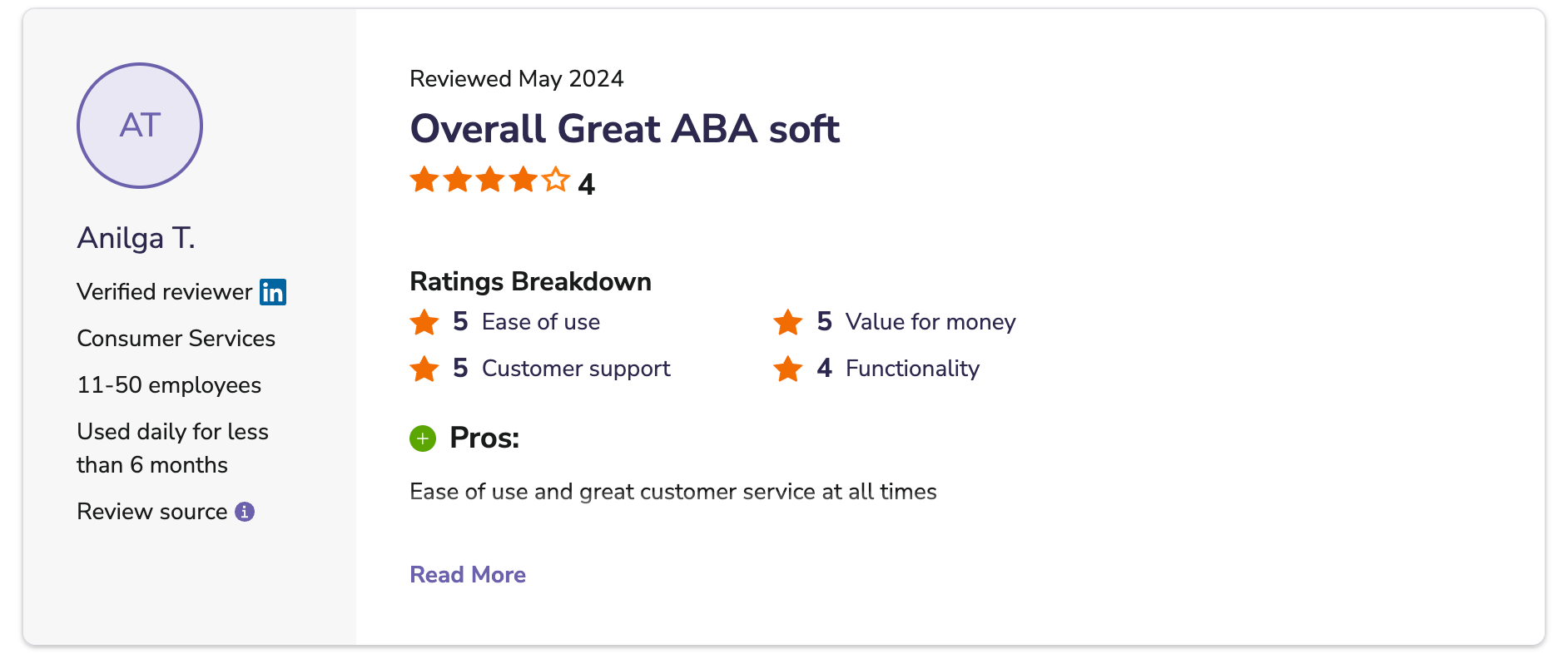
“Very user friendly product and a great team to work with” – Mariah A., Verified User, Software Advice Review
“Software is good, the user interface could be better” – Connor N., Verified User, Software Advice Review
Pricing
- Practice management: $29.99/user/month
- Data Collection: $10.00/user/month, only available as an add-on
AlohaABA also offers a managed billing service, with a custom quote.
Bottom line
AlohaABA handles the operational side of practice management well, and the scheduling and billing connection is useful for growing clinics. Practices that need strong clinical program management alongside those tools will need to bring in a second platform to fill the gap.
6. Theralytics: Best for newer and budget-conscious practices
What it does: Theralytics is a BCBA-built platform that pulls scheduling, treatment plan templates, data collection, billing, payroll, and session documentation into one system.
Best for: Practices in their early stages, solo BCBAs, and budget-conscious clinics that want a straightforward, no-contract platform covering the core bases.
Theralytics gets the fundamentals right and keeps pricing transparent. The workflows make sense from a clinical standpoint, and the Start-Up Package is a plus for practices getting off the ground. Where it struggles is depth: reporting is basic, integrations are limited, and some users flag reliability issues with the app.
Key features
- Treatment plan templates: Access a library of programs and adjust them to fit each learner.
- Payroll and scheduling link: Staff hours pull directly from completed session records, reducing manual cross-checking.
- Multi-site calendar: Coordinators can manage bookings across different clinic locations without switching between views.
- Drive time tracking: The platform records travel between appointments for staff working at multiple locations, which is useful for payroll and scheduling.
- BCBA Start-Up Package: New practices have free access to get their workflows established, either for 6 months or until their first client starts.
Pros
✅ Pricing is publicly available.
✅ Clinical workflows are designed around how BCBAs and RBTs work.
✅ The Start-Up Package makes it accessible for newer practices.
Cons
❌ Reporting tools are basic, compared to most other platforms on this list.
❌ Multiple users have flagged app reliability issues, including deleted appointments.
❌ There are limited options for connecting with third-party tools.
What users say
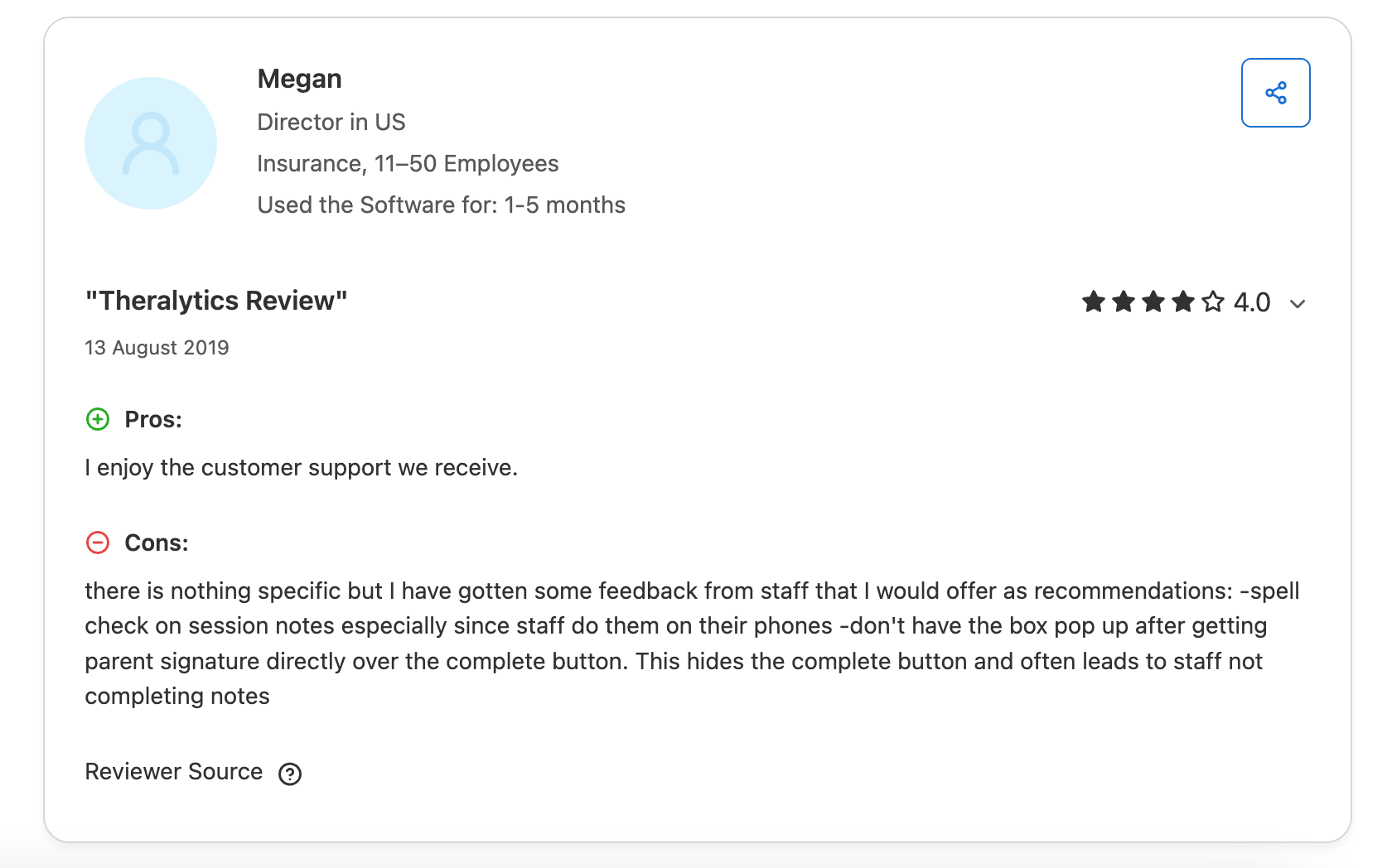
“Overall experience is great still learning all the features would like more explanation/videos on how to use certain features” – Jaclyne, Administrative Coordinator, Capterra Review
“Therapytics often has glitches, and appointments get deleted.” – Jessica, CEO in US, Capterra Review
Pricing
- Practice Management: $20/client/month or $30/user/month (minimum $200/month)
- Data Collection: $20/client/month or $30/user/month (minimum $200/month)
- Practice Management + Data Collection: $30/client/month or $45/user/month (minimum $300/month)
- BCBA Start-Up Package: Free for the first 6 months, or until your first client begins
Bottom line
Theralytics is a valid option for solo BCBAs and smaller practices that need core treatment planning and scheduling tools. The gaps in reporting and integrations are manageable early on, but practices that grow quickly will likely need a more capable platform.
Which mental health treatment plan software should you choose?
Picking the right platform comes down to what your practice actually needs day to day, not which tool has the longest features list.
Choose Passage Health if you:
- Are managing a growing caseload across a busy clinical team
- Need treatment planning, scheduling, billing, and data collection working together in one system
- Are losing hours to manual data reentry between disconnected tools
- Want a platform built specifically for ABA, with hands-on onboarding support from day one
Choose Motivity if you:
- Need control over how programs are built and data is collected
- Have the time to invest in configuring the platform before it runs smoothly
- Are happy to manage billing and scheduling with separate tools
Choose Hi Rasmus if you:
- Put BCBA supervision quality and clinical documentation at the top of your list
- Already have a practice management system for billing and scheduling
- Want AI-generated session notes to take some documentation load off supervisors
Choose RethinkBH if you:
- Offer services across multiple therapy disciplines alongside ABA
- Need a built-in staff training library to support onboarding and certification
- Can work around slower system performance and variable support response times
Choose AlohaABA if you:
- Need scheduling, billing, and treatment documentation running in one place
- Want responsive customer support as part of the package
- Are open to adding a dedicated clinical tool for more complex program management
Choose Theralytics if you:
- Are launching a new practice or running a smaller clinic on a tighter budget
- Want transparent, published pricing
- Need a platform that covers the core bases without unnecessary complexity
See how Passage Health handles treatment planning
Most platforms on this list do one thing well: the clinical tools are strong but disconnected from billing. Or the operational side is polished, but the clinical documentation is thin.
Passage Health connects both sides in one system, so as your caseload grows, you're not losing revenue to denied claims or wasting time juggling disconnected tools.
Here's what Passage Health offers:
- Mobile app data collection: Notes and data are captured in real time during sessions, with automatic syncing, so nothing gets lost.
- Client intake management: Manage your full intake pipeline in one place, from the initial caregiver form through to client conversion, with no external tools required.
- Customizable treatment reports and progress graphs: Reports and visuals build directly from session data, and they’re formatted for insurance reauthorization from the start.
- Scheduling tools: Color-coded calendar views, easy staff reassignments, and real-time mobile access for BCBAs make scheduling simple.
- Electronic billing: Session data flows directly into claims without manual reentry, and authorization tracking flags limits before sessions take place.
- Reporting and insights: Having practice performance and utilization data in one place gives owners and clinical directors a clear view.
- Frontera AI integration: Clinical AI features help develop documents faster, freeing up your time to focus on learners.
- Quarterly feature releases: The platform develops fast, with new features added every quarter.
- 1:1 onboarding support: A dedicated team that understands ABA workflows supports clients from day one.
Getting treatment plans right is an ongoing process. Passage Health gives BCBAs the data they need to keep adjusting and improving programs session by session, without the delays caused by piecing together information across disconnected systems.
Book a demo today to see how Passage Health connects treatment planning, data collection, and billing for ABA practices of any size.
Frequently asked questions
What is mental health treatment plan software for ABA practices?
Mental health treatment plan software helps BCBAs create, manage, and track treatment goals for each learner in ABA therapy. These platforms should cover goal documentation, session data collection, progress reporting, and insurance reauthorization as a minimum.
What should ABA treatment plan software include?
ABA treatment plan software should include individualized goal-setting tools and documents for collecting data using different techniques, as well as automated progress graphing and authorization tracking. Platforms that connect clinical documentation directly to billing and scheduling reduce the manual work that builds up as your caseload grows.
How does treatment plan software reduce claim denials for ABA practices?
Treatment plan software reduces claim denials by feeding session data directly into the billing module without manual reentry. This removes the step where most errors enter the process. Platforms that also track and flag authorization limits before sessions take place catch the most common source of denials.
Can ABA treatment plan software support insurance reauthorization?
Yes, ABA treatment plan software supports insurance reauthorization by generating progress reports directly from session data at the end of each treatment cycle. Passage Health produces customizable treatment reports automatically, so BCBAs spend less time on documentation and more time on clinical work.
