

7 Best EHR Software for Therapy Practices in 2026


For therapy and behavioral health practices, the wrong electronic health record (EHR) tools create more problems than they solve, like disconnected documentation, billing errors, and compliance headaches.
We’ve looked at the best EHR software in 2026, weighing up their pros and cons, and which actually benefit therapy workflows.
7 best EHR software: At a glance
1. Passage Health: Best EHR software overall for therapy practices
What it does
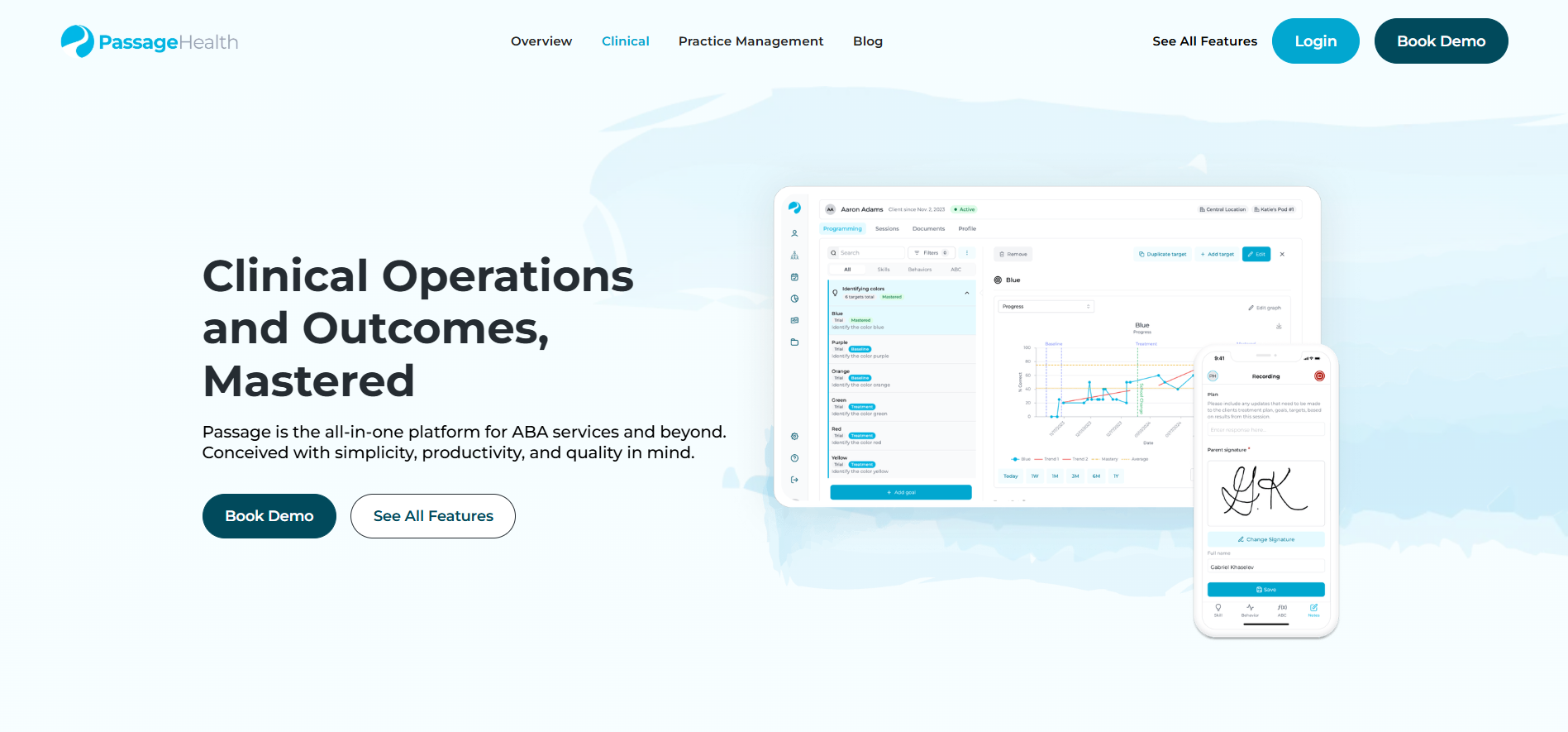
Combines clinical documentation, scheduling, supervision, and billing in one connected system.
Who it’s for
This clinical and practice management platform is for Applied Behavior Analysis (ABA) and autism therapy practices that need structure without extra admin.
What makes Passage Health different is that clinical work and billing aren't treated as two separate jobs. Your sessions, supervision records, credentials, and claims are connected from the start, not stitched together manually.
If you use too many systems, errors can pile up in ways that aren't obvious until a claim gets denied. These mistakes could be a rescheduled session tied to the wrong code, a supervisor's credentials being out of sync, or exceeding authorization limits.
Passage Health sidesteps these problems by building billing into the workflow clinicians already use for documentation and scheduling.
Key features
- Mobile app data collection: Record session data in real time with auto-syncing, so nothing gets lost between the session and the chart.
- Treatment reports and graphing: Automatically visualize client progress with customizable treatment reports and graphs.
- Scheduling: Set up appointments, reassign staff, and manage your calendar with color-coded views.
- Automated coding rules: Set billing coding rules across payers and event types, so claims are coded correctly without manual intervention.
- Reporting and insights: Track practice performance and utilization without pulling data manually.
Pros
- Designed for therapy, not general medicine
- Reduces billing and documentation errors
- Cuts down on denied claims from credential mismatches
- Keeps clinical work and billing connected in one system
- Tracks supervision without extra spreadsheets or manual logging
- Makes audits far less painful
Cons
- It’s not built for hospitals or surgical settings.
- Pricing is custom, not listed online.
Pricing
Custom pricing is based on your practice size and needs. Contact Passage Health for a quote.
Bottom line
If you run an ABA or autism therapy practice, Passage Health is the strongest all-in-one EHR software. It keeps clinical care, compliance, and billing aligned without spreadsheets or workarounds.
You can book a demo with Passage Health to find out more.
2. AdvancedMD: Best for medical billing complexity

What it does
AdvancedMD is big on billing, especially for traditional medical services. During testing, its claim management abilities stood out, but its therapy workflows felt like an afterthought.
Who it’s for
Medical practices with complex insurance workflows.
Key features
- Advanced claims and revenue tools
- Customizable templates
Pros
- Solid billing features
- Scales well for medical clinics
Cons
- Steep learning curve
- Less intuitive for therapy teams
Pricing
The cost varies by practice size and features. You’ll have to contact AdvancedMD for a quote.
Bottom line
AdvancedMD works well for medical-heavy practices, but therapy teams might find it’s more complex than they need.
3. TherapyNotes: Best for mental health notes
What it does
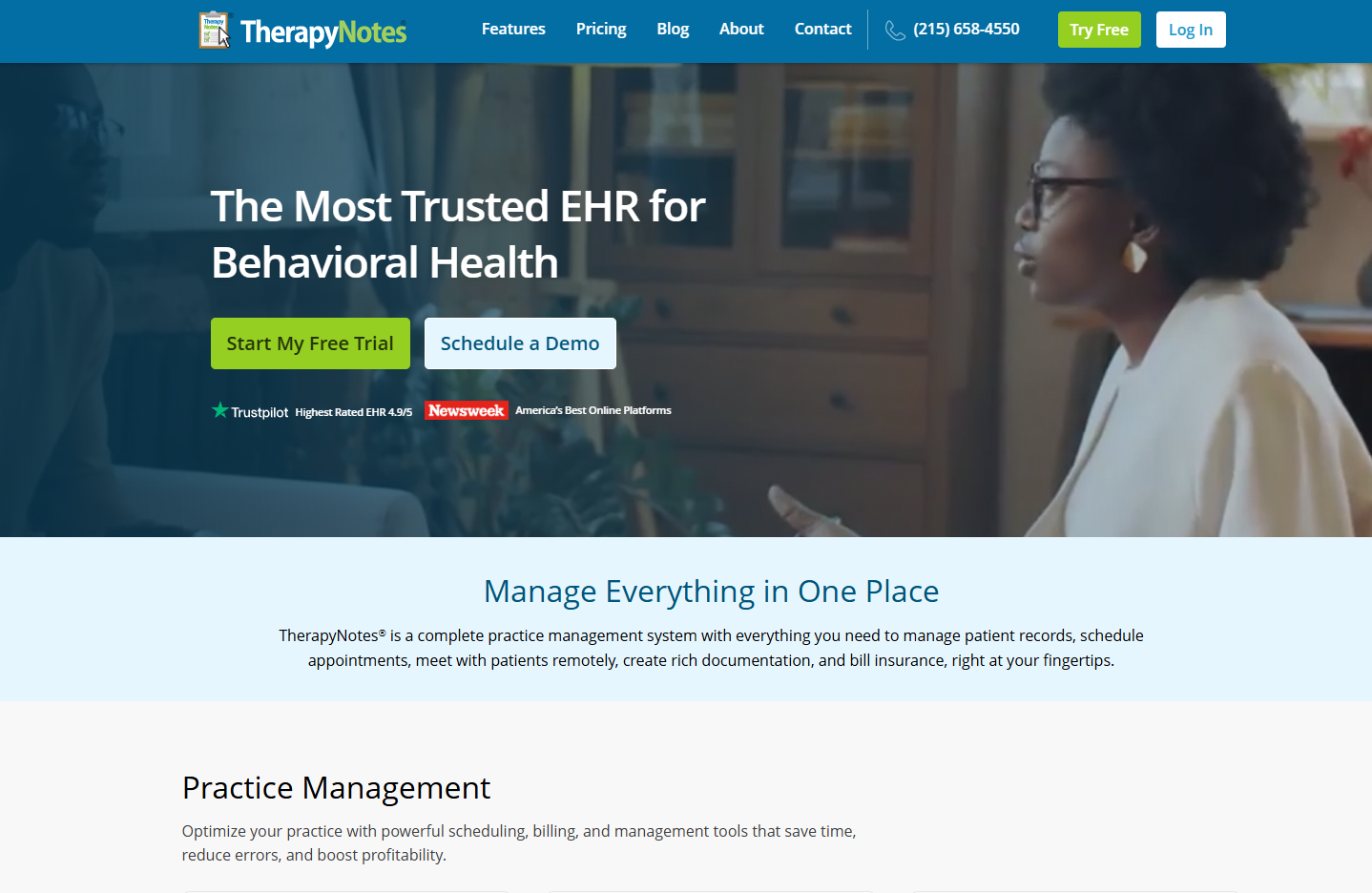
TherapyNotes focuses on note writing for mental health providers. Documentation is clean and simple, but billing and data tracking feel like secondary features.
Who it’s for
Counselors, psychologists, and other behavioral health practitioners who want fast but simple documentation.
Key features
- Structured note templates
- Appointment reminders
Pros
- Clean interface
- Fast note completion
Cons
- Basic reporting only
- Less flexible workflows
Pricing
Starts from $69 for a solo practitioner per month.
Bottom line
Great for notes, but less helpful for growing practices that need billing depth.
4. CentralReach: Best for large, multi-location ABA organizations
What it does
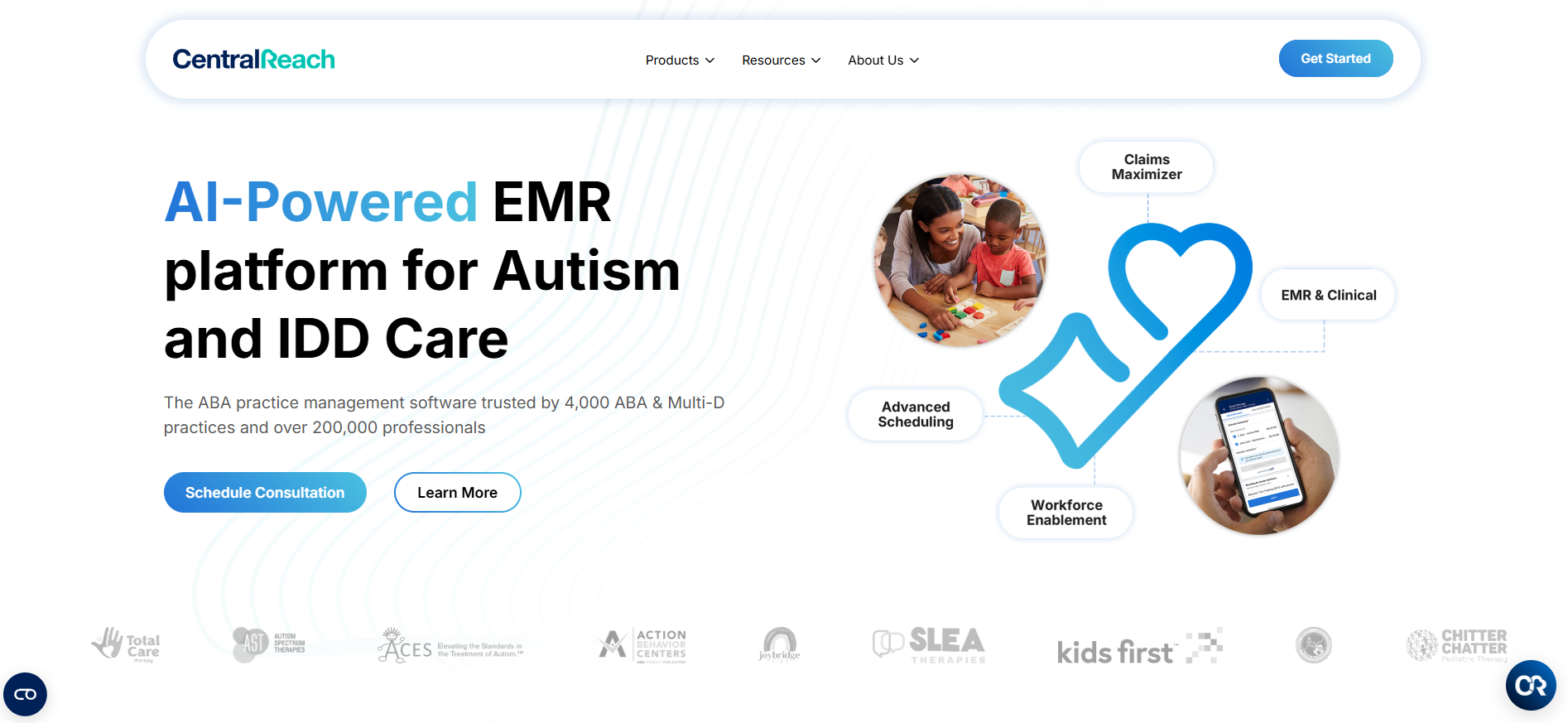
CentralReach is an ABA practice management platform covering scheduling, billing, data collection, and payroll. It's built for large organizations, so for anyone without a dedicated implementation team, this platform’s complexity may limit its usefulness.
Who it’s for
Large, multi-location ABA organizations with dedicated admin and IT staff.
Key features
- Scheduling, billing, and data collection across multiple locations
- Payroll processing and staff credentialing
- Cross-site reporting and compliance tracking
Pros
- Covers payroll
- Can handle multi-site operations
Cons
- Steep learning curve
- Add-on fees quickly driving up costs
- Reliability complaints, including session notes failing to save
- More than most growing practices need
Pricing
Custom quote. Contact CentralReach directly.
Bottom line
CentralReach suits enterprise ABA organizations with the staff and budget to run it. For practices without a dedicated implementation team, the complexity and cost can be hard to justify.
5. RethinkBH: Best for staff training and clinical curriculum

What it does
RethinkBH combines scheduling, billing, and data collection with a built-in training library. The staff training resources are its main draw; the practice management tools are thinner than those of dedicated ABA platforms.
Who it’s for
ABA and behavioral health practices where staff training is a core operational need.
Key features
- Scheduling, data collection, billing, and reporting
- Built-in clinical curriculum and staff training video library
- Supports ABA, mental health, and education settings
Pros
- Built-in training library
- Works across clinic, home, and school settings
Cons
- Lighter billing and practice management depth
- Customer support dropping off after onboarding
- Slow loading times when saving data or appointments
- Scales poorly when adding new service lines
Pricing
Custom quote. Contact RethinkBH directly.
Bottom line
RethinkBH has a clear niche in staff training. Outside of that, its practice management tools don't keep pace with those of purpose-built ABA platforms.
6. Theralytics: Best for small and startup ABA practices
What it does
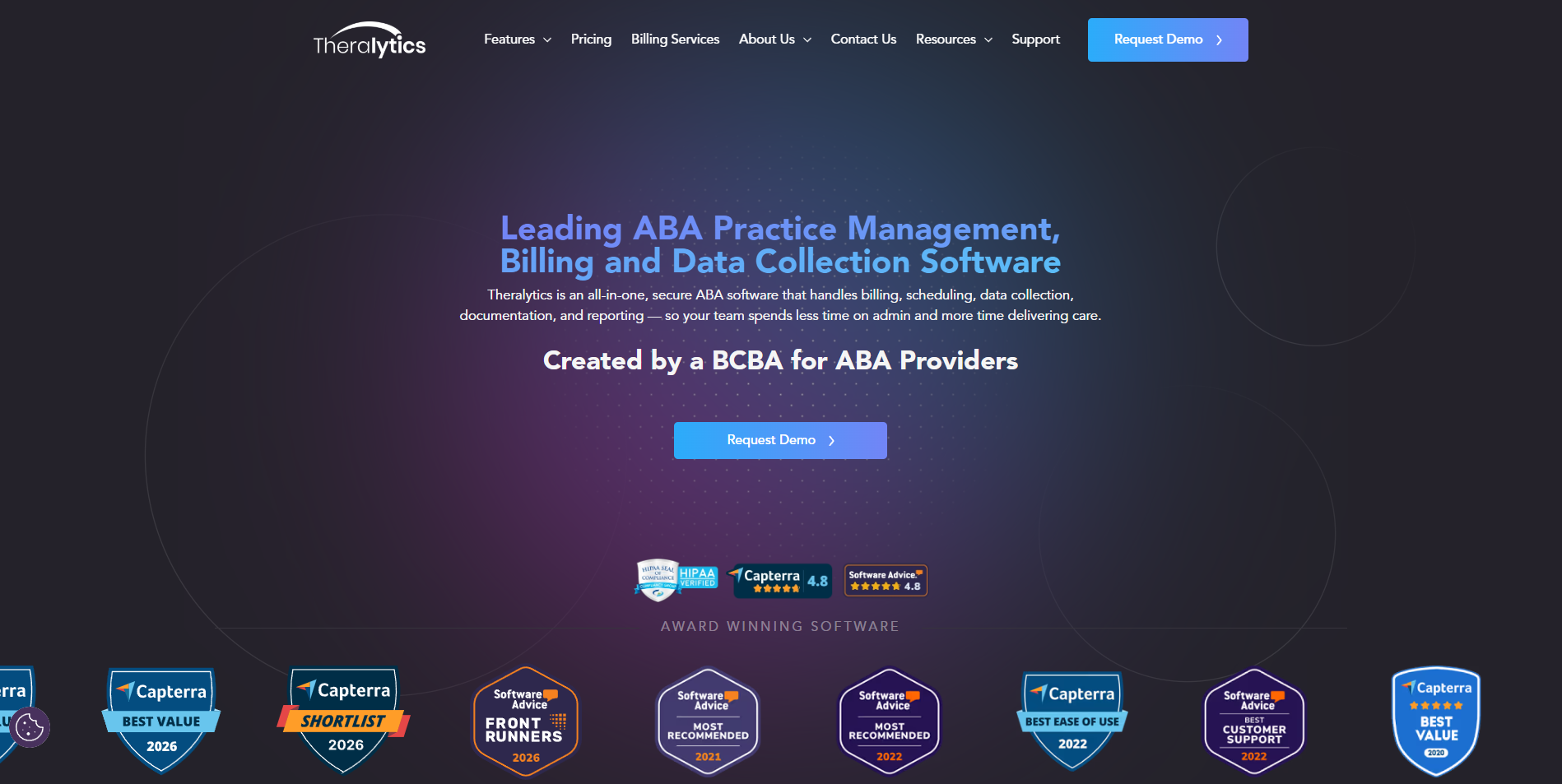
Theralytics is a practice management platform covering scheduling, billing, data collection, and reporting. It's a lightweight option, and its reliability issues are worth factoring in.
Who it's for
Solo BCBAs and startup ABA practices looking for a low-cost entry point.
Key features
- Scheduling, billing, payroll, and data collection
- Business analytics dashboards
- Eligibility checks and automated billing reminders
Pros
- Quick to set up
- Affordable for smaller practices
Cons
- Session notes failing to save reliably, users report
- Limited billing customization for specific payers
- Often having to track compliance outside the platform
Pricing
Theralytics charges $20 per client per month for practice management, or $30 per user per month. Bundling practice management with data collection costs $30 per client per month (or $45 per user per month). New practices can access the platform free for six months through the BCBA Startup Package, with a $200 or $300 minimum monthly fee once paid plans begin (depending on which you choose).
Bottom line
Theralytics may work for a solo BCBA or new practice with light session volume. The note-saving issues are a hard limitation for any practice where losing clinical data mid-session isn't an option.
7. SimplePractice: Best for solo clinicians
What it does
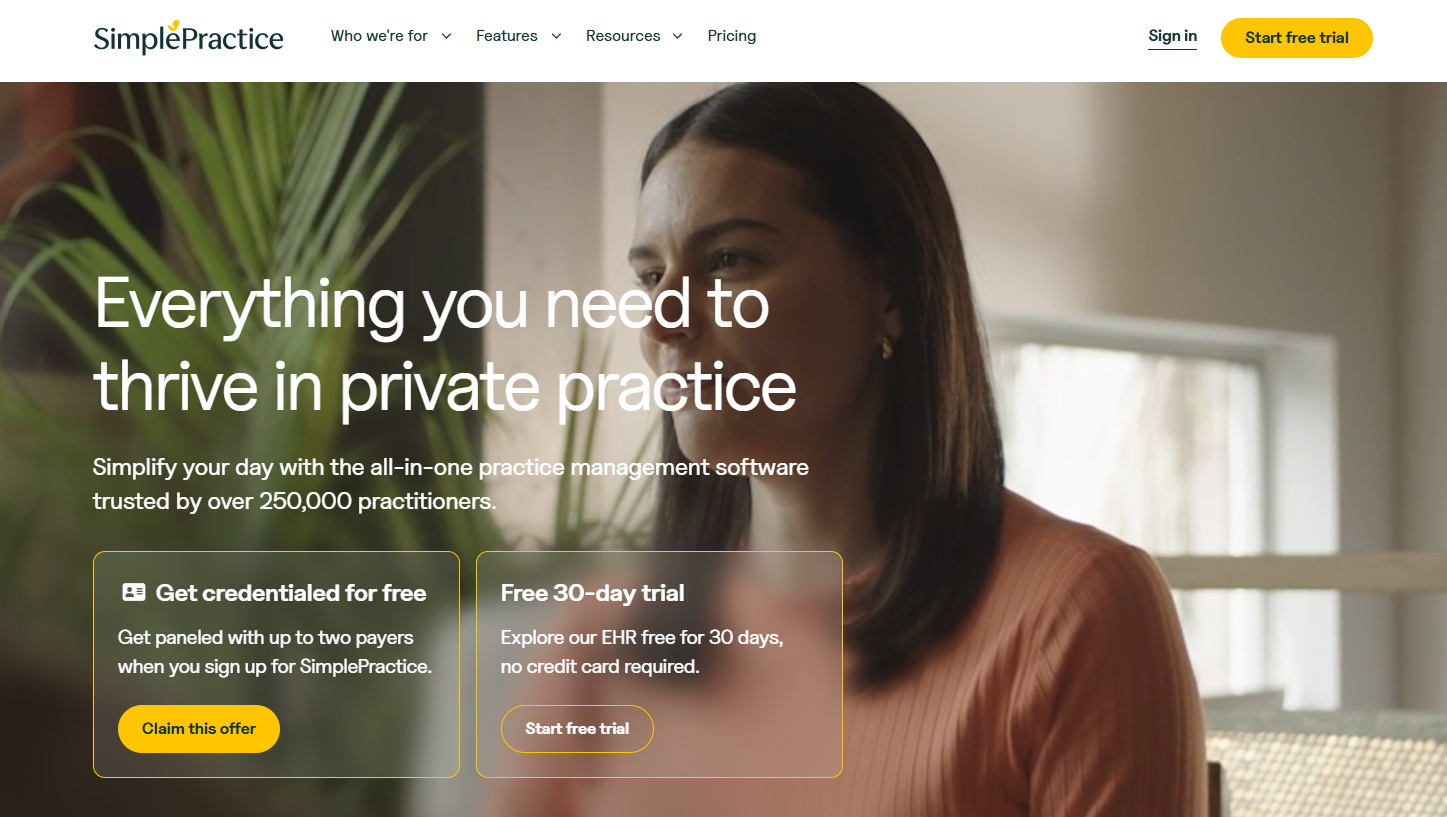
As the name suggests, SimplePractice is a general-purpose EHR for small practices with a simple setup process. It supports everyday workflows but lacks tools for supervision tracking or managing teams with multiple roles.
Who it’s for
Solo clinicians or small group practices.
Key features
- Simple onboarding process
- Client portal for scheduling and messaging
Pros
- Easy setup
- Clean, user-friendly design
Cons
- Limited compliance depth
- Pricing per clinician, which can get expensive
- Not built for ABA or supervision-heavy care
Pricing
Starts from $49 per clinician per month.
Bottom line
A good fit for solo clinicians who need simplicity, but larger teams or ABA practices will likely hit its limits.
How we tested these EHR software tools
We checked each platform through live demos, then researched user feedback on Reddit and other review sites to see how these tools perform in practice.
Throughout, we focused on what therapy and behavioral health practices need most, like:
- Clinical workflow fit: Does the system match how sessions actually run?
- Billing and documentation connection: Are Current Procedural Terminology (CPT) codes, credentials, and session data linked automatically?
- Compliance and security: Does the software protect client data and meet compliance standards?
- Reporting clarity: Can you pull the reports you need without extra steps?
- Learning curve: How quickly can staff learn to use the system correctly?
Platforms that made these tasks easier scored higher. Those that required more manual work or extra steps scored lower.
Which EHR software should you choose?
Disconnected systems mean disconnected data, and that's where claim denials and compliance issues start.
The right EHR should match your actual workflows, not force you to work around them.
Choose Passage Health if you:
- Run ABA or autism therapy services
- Need supervision tied to sessions and credentials
- Want fewer billing errors
- Prefer clinical work, scheduling, and billing in one place
- Need reports ready for audits and compliance
Choose another tool if you:
- Only offer medical services
- Need hospital or enterprise-level features
- Want pricing listed online
- Don't bill for insurance
The final verdict
Most EHR software is designed with medical practices in mind, leaving therapy teams to adapt.
Passage Health takes the opposite approach: It's built around how ABA and autism therapy practices actually work.
If you need clinical documentation, supervision tracking, and billing to stay connected without extra admin work, Passage Health is the clearest fit.
Get started with Passage Health
If your clinical notes live in one system, billing in another, and supervision records in a spreadsheet, mistakes are bound to happen.
Passage Health brings everything together so your team spends less time on admin and more time on client care.
The platform is designed specifically for ABA and autism therapy practices, so you won't have to force your workflows into a system built for hospitals or general medicine.
Book a demo to see how Passage Health can simplify your EHR workflows and take the stress out of day-to-day tasks.
Frequently asked questions
What’s the best EHR software for therapy practices?
The best EHR software for therapy practices is Passage Health. It connects documentation, supervision, and billing in one system, which reduces errors and saves time for clinicians and admin staff.
What does EHR software do?
EHR software stores clinical records, session notes, and billing data. It helps practices stay compliant, organized, and ready for audits.
Is EHR software required?
EHR software is required by most payors and regulations. It also improves accuracy and makes reporting easier.
How does EHR software improve care?
EHR software improves care by supporting better coordination between clinicians. This helps teams stay aligned on treatment goals and access client information when they need it.
References
ABA Coding Coalition. (n.d.). Billing codes. Retrieved from https://abacodes.org/codes/
Centers for Medicare & Medicaid Services. (n.d.). Promoting interoperability programs. Retrieved from https://www.cms.gov/medicare/regulations-guidance/promoting-interoperability-programs
Graetz, I., Reed, M., Rundall, T., et al. (2009). Care coordination and electronic health records: Connecting clinicians. AMIA Annual Symposium Proceedings Archive, 2009, 208–212. Retrieved from https://pmc.ncbi.nlm.nih.gov/articles/PMC2815429/
