

5 Best EHR Software for ABA Private Practices in 2026


Choosing the best electronic health record (EHR) software for your private practice means finding a platform built around how Applied Behavior Analysis (ABA) teams actually work, not one designed for hospitals, then adapted. We reviewed the top software options in 2026 to help you find the right fit for your practice.
5 best EHR platforms for private practice: Quick comparison
How we evaluated these EHR platforms
The best EHR software for ABA private practices connects clinical documentation, scheduling, supervision, and billing in one system.
When these aspects of your workflow live in separate systems, errors can build up: a session note doesn't match a claim, a credential lapses, and an authorization limit is exceeded without a flag.
We assessed how well top platforms meet the core needs of ABA private practices, taking into account:
- Clinical fit: Does the system reflect how ABA sessions actually run, including data collection and program tracking?
- Billing integration: Are CPT codes, credentials, and session data linked automatically, or does your team have to handle each manually?
- Supervision support: Can the platform track supervision hours without extra spreadsheets?
- Compliance and audit readiness: How quickly can you produce documentation when a payor requests it?
- Ease of use: How fast can new Registered Behavior Technicians (RBTs) and Board Certified Behavior Analysts (BCBAs) get up and running?
Platforms that met each of these criteria within a single system scored the highest.
1. Raven Health: Best for small practices that need a quick, simple setup
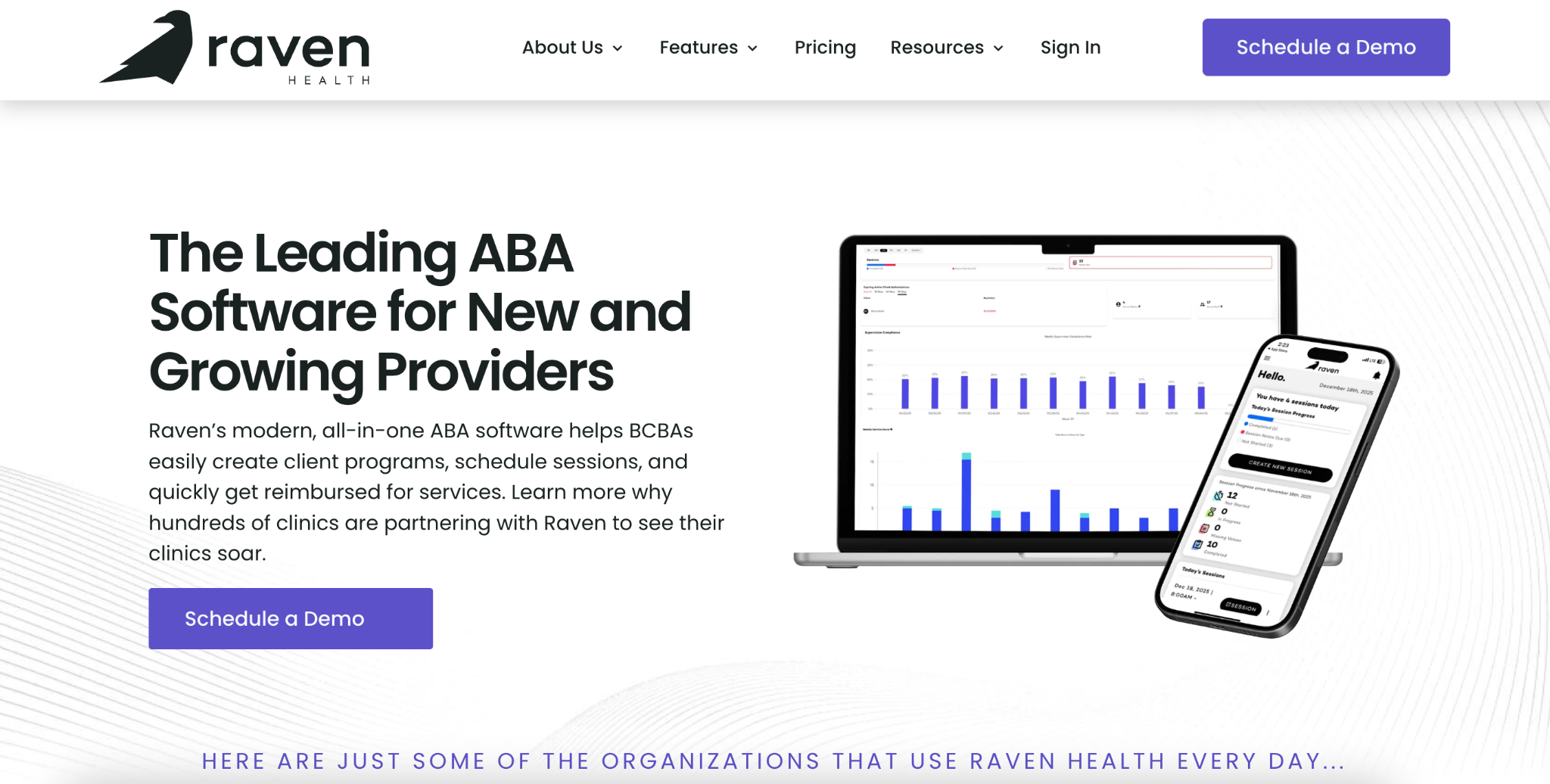
What it is: An all-in-one ABA platform that combines clinical documentation, data collection, treatment planning, billing, and scheduling. It focuses on ease of use and mobile access.
Best for: Small ABA practices that need core EHR functionality up and running quickly, without lengthy implementation or heavy training.
Raven Health is designed to be accessible and simple. The interface is clean, the mobile experience holds up well during sessions, and new staff tend to get comfortable with it faster than most alternatives.
The trade-off is depth. As practices take on more clients and billing complexity increases, the platform's clinical reporting and authorization management start to show their limits.
Key features
- Mobile access with offline capability
- AI-generated session documentation
- Treatment planning tools
- Session-linked invoicing
- Automated recurring appointments
Pros
✅ Quick to get up and running
✅ Polished mobile experience that works offline
Cons
❌ Clinical reporting and analytics are limited, compared to more capable platforms.
❌ Billing integration lacks the depth that growing practices typically need.
❌ Some customers report intermittent technical issues.
What users say
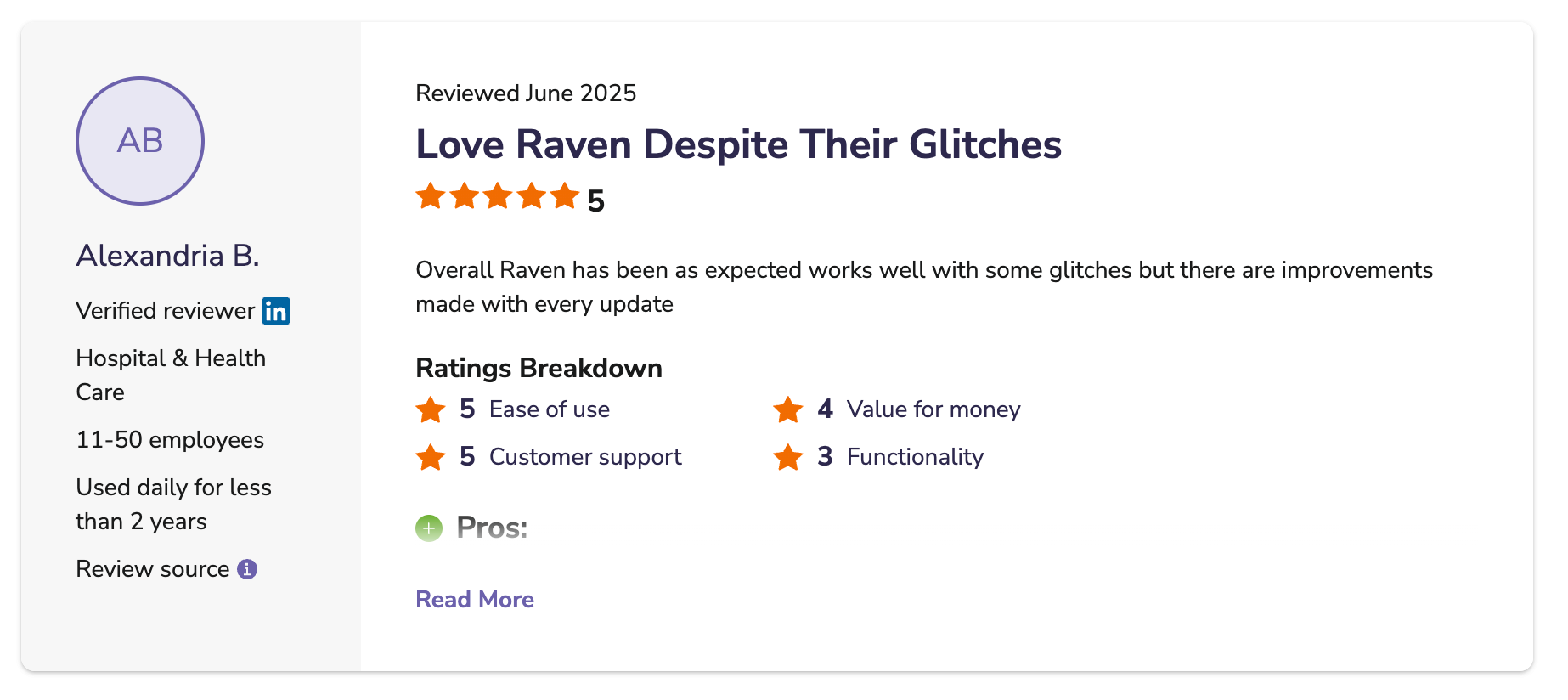
“The platform features a straightforward layout with essential functionalities tailored for professionals in the ABA field.” – Mark L., Verified Reviewer, Software Advice Review
“Some of the features are lacking on the BCBAs side of the platform for viewing and reporting on data when updating treatment plans.” – Christopher S., Verified Reviewer, Software Advice Review
Pricing
- The entry tier starts at $29/client/month, with an annual commitment and a one-time $500 implementation fee. Unlimited users are included.
- Billing managed by Raven runs at 5% of claims collected monthly, with the implementation fee dropped.
- Practices with 50+ clients can request a custom quote for the self-billing option.
Bottom line
Raven Health is a good starting point for smaller practices that want something functional without a hefty setup. Once caseloads grow and documentation or billing requirements become more complex, its limitations tend to surface.
2. RethinkBH: Best for ABA practices that need clinical tools and staff development
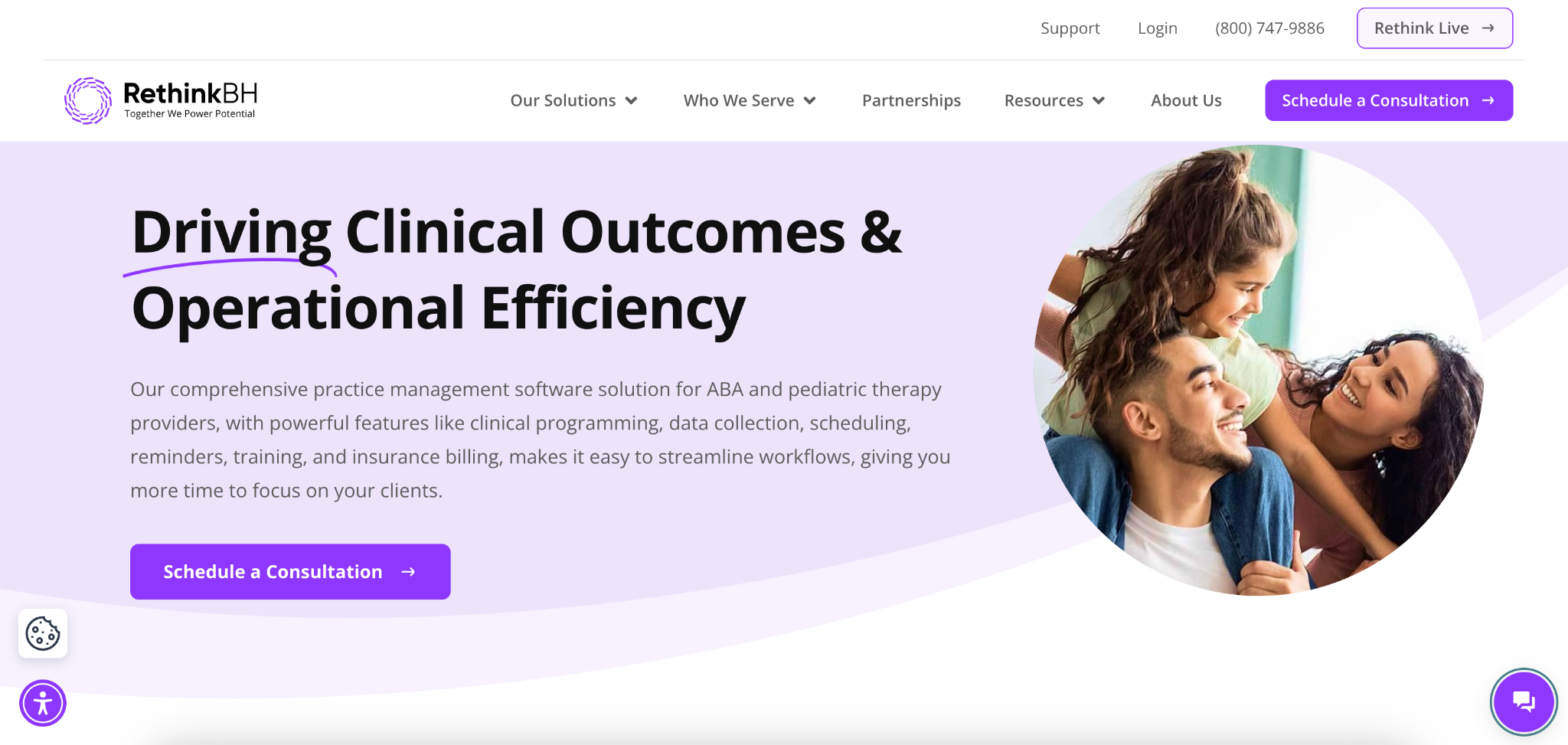
What it is: A modular ABA platform that can cover clinical documentation, data collection, staff training, scheduling, and billing.
Best for: ABA practices looking for clinical programming tools and built-in staff development resources. RethinkBH can package these together with documentation, reducing the need for separate tools in those areas.
The modular pricing structure makes it difficult to assess the total cost before you contact them. User feedback suggests that the platform works reasonably well for smaller or single-service practices, but limitations crop up as organizations grow or diversify.
Key features
- Customizable care plan library
- Built-in RBT training and staff development tools
- Scheduling and practice management
- Billing tools with an outsourced option
- Reporting and analytics
- Medical necessity assessment
Pros
✅ Covers ABA alongside speech, occupational, and physical therapy workflows
✅ Staff training and clinical tools in one place
✅ Credentialing and enrollment support available
Cons
❌ Module-based pricing makes cost comparison difficult up front.
❌ Support response times are a recurring complaint in reviews.
❌ There’s no drag-and-drop scheduling.
What users say
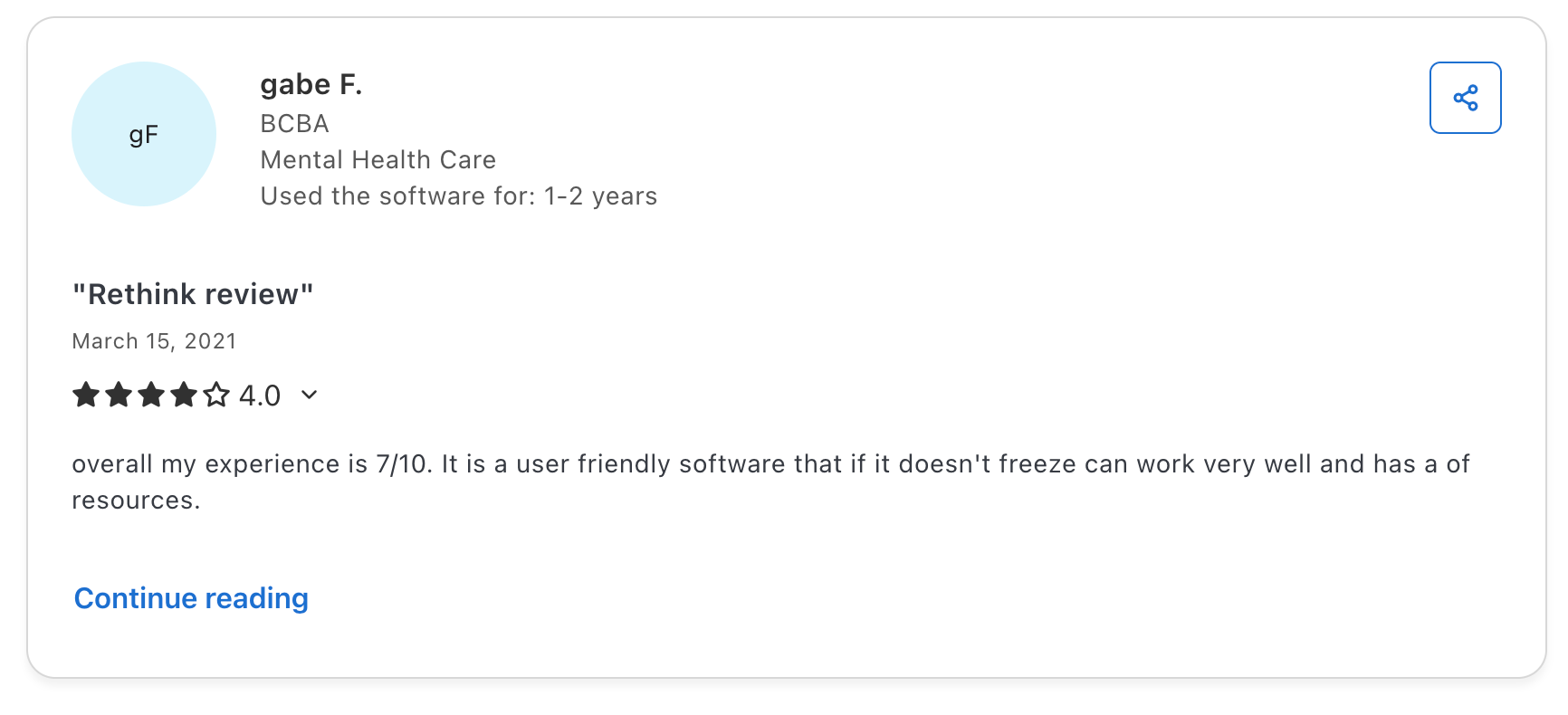
"Very useful and easy to learn how to use." – Jobe, RBT, Capterra
"Overall, Rethink worked when we were a small, ABA-only organization. As we grew and started to provide different services and different service lines, it did not work. Even worse, when we went to leave Rethink, they stopped responding. The customer service is deplorable." – Jen G., Director, Capterra
Pricing
Custom pricing based on practice size and module selection.
Bottom line
RethinkBH combines a range of clinical and training tools, but what you get depends heavily on which modules you configure. Practices looking for full integration from day 1 may find that the build-your-own approach creates roadblocks rather than offering flexibility.
3. Ensora Health: Best for mental health and rehab therapy practices
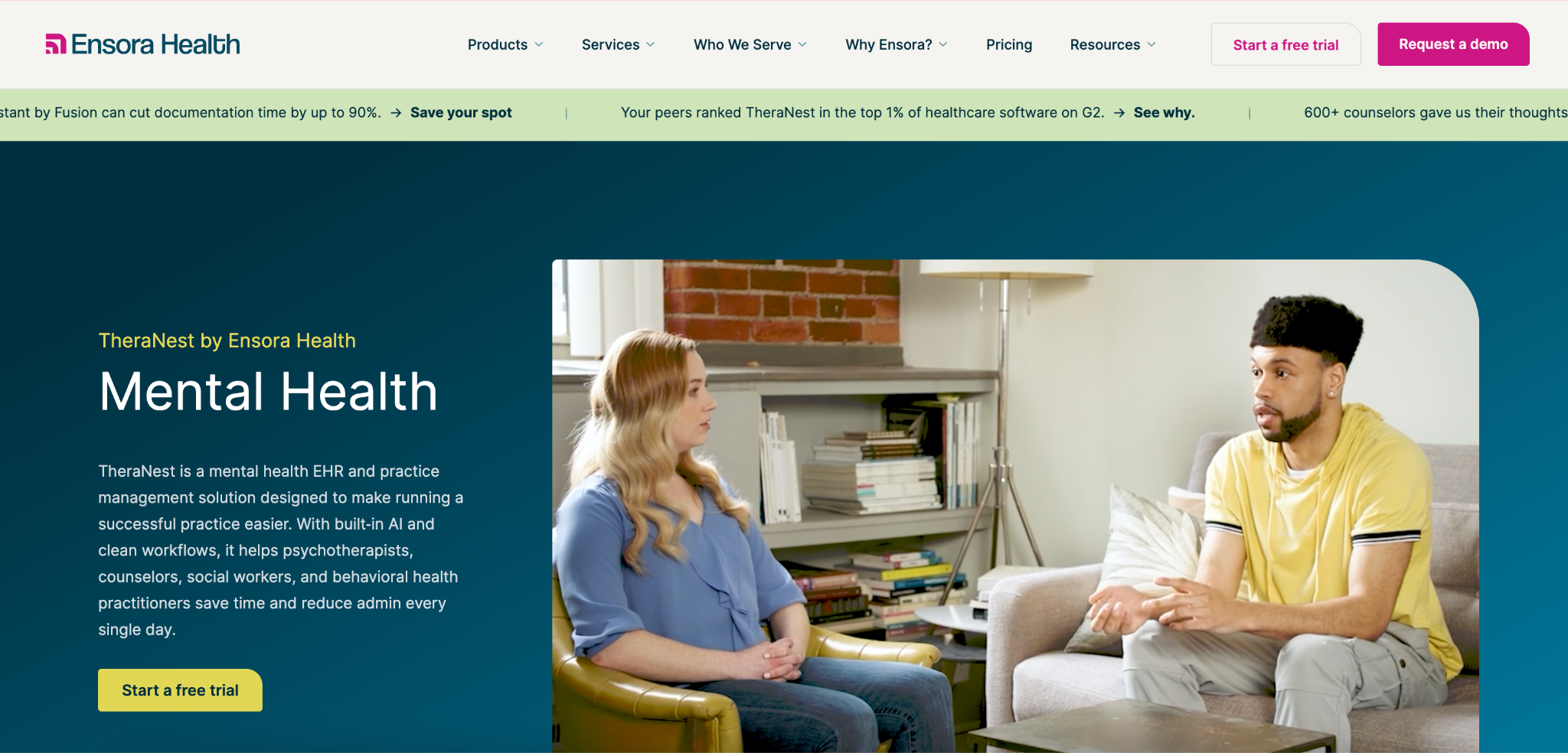
What it is: A practice management platform that offers scheduling, billing, and revenue cycle management (RCM) for mental health and rehab therapy practices.
Best for: Mental health, and physical, occupational, and speech therapy practices that need billing and scheduling tools.
Ensora Health's core products are TheraNest, built for mental health therapists, and Fusion, built for physical, occupational, and speech therapists. Neither platform includes ABA data collection, ABA-specific billing codes, or authorization tracking structures that ABA practices rely on.
Also, reviews consistently flag a gap between what practices are promised during the sales process and what the platform delivers in daily use.
Key features
- Intelligent group scheduling
- Insurance billing and RCM
- Parent portal and document management
Pros
✅ Published pricing for TheraNest and Fusion
✅ 21-day free trial for TheraNest
✅ Mobile app available for iOS and Android
Cons
❌ No session data collection, ABA billing codes, or Medicaid waiver structures
❌ Recurring reports of lags and glitches, particularly during busy periods
❌ Repeated user complaints about customer support responsiveness
❌ No native application programming interface, which limits how far you can extend the platform with other tools
What users say
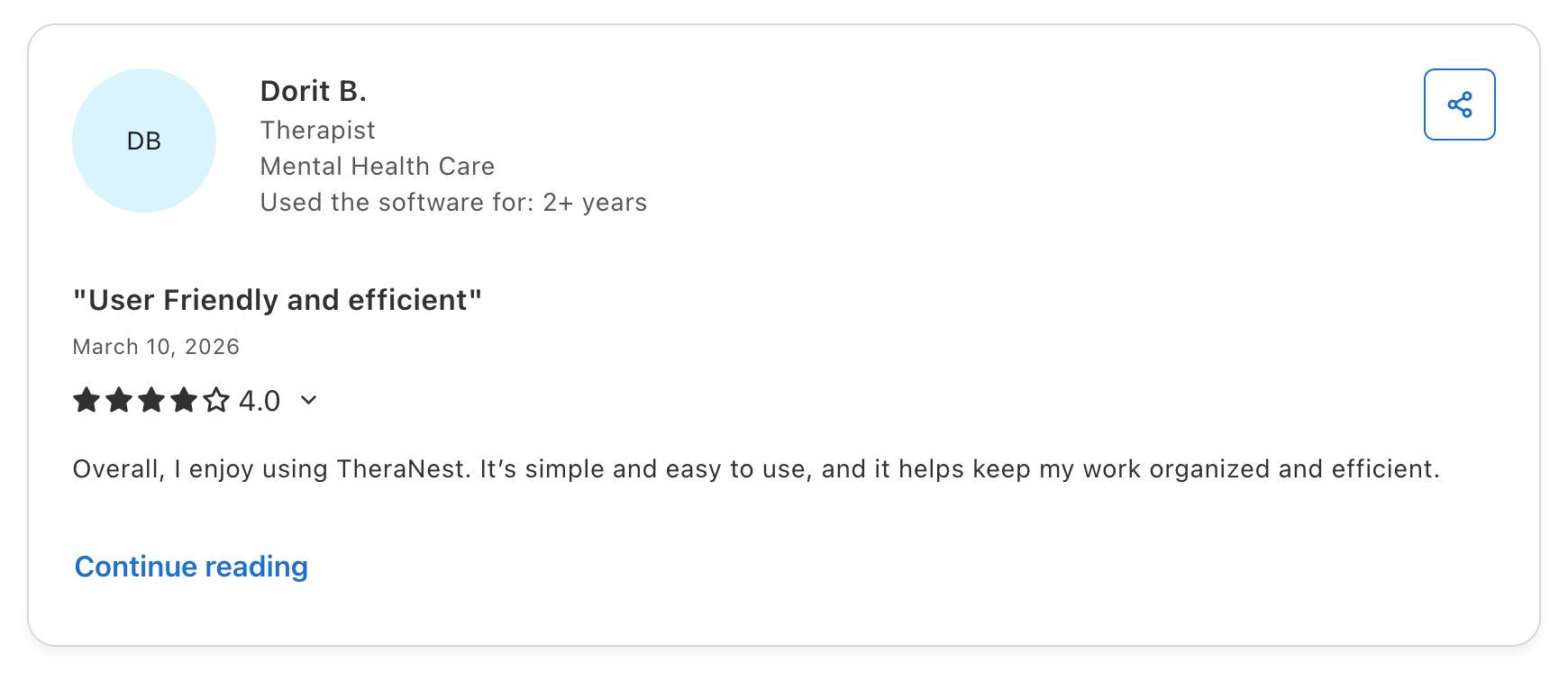
“Overall I really like the app and really appreciate how it makes my job much easier. I'm able to store information and obtain the information and organized way.” – Cynthia R., Therapist, Capterra
“When everything works it's ok, but when something breaks, it makes work impossible.” – Zuzanna G., Mental Health Therapist, Capterra
Pricing
TheraNest starts at $29/therapist/month and Fusion at $119/first user/month. Each has three pricing tiers. Ensora RCM is available as a standalone or add-on billing service, with custom pricing.
Bottom line
Ensora Health works well for mental health and rehab therapy practices that want transparent pricing for the core modules. If you run an ABA practice, none of these products covers what you need.
4. Motivity: Best for clinical data collection depth
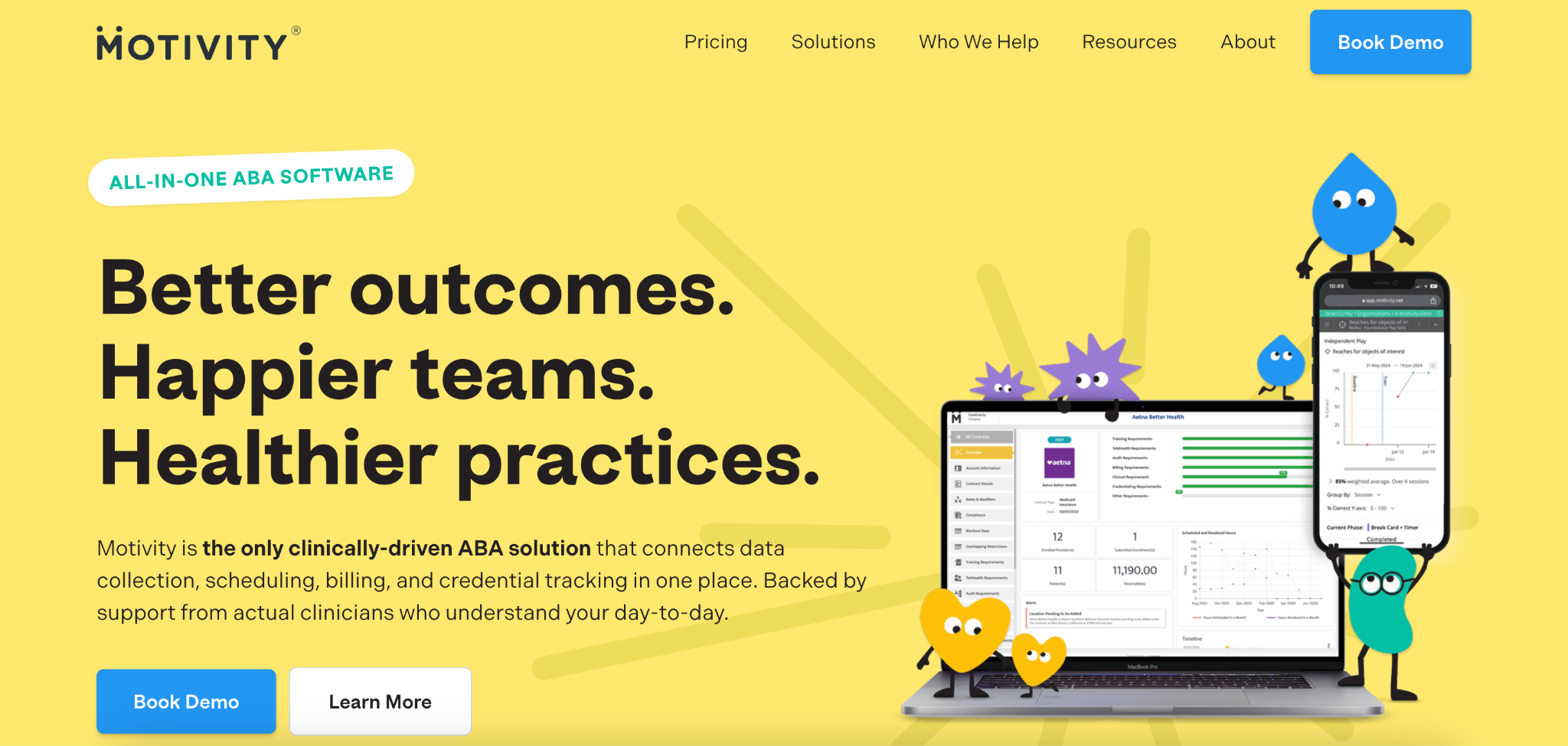
What it is: A data collection and clinical documentation platform with practice management features. It’s suitable for ABA and multidisciplinary practices, and it was built with National Institute of Mental Health research grants.
Best for: ABA practices that prioritize deep, customizable clinical data collection.
Motivity's program builder is its clearest strength. BCBAs can build highly customized behavioral programs, and the data collection tools are detailed and flexible.
The administrative side is where it falls short. Billing, payroll, and practice management features aren't as developed as the clinical tools, and some reviewers say practice management seems like it was a secondary consideration.
Key features
- No-code behavioral program builder
- Real-time data collection and live progress charts
- Credential tracking and authorization alerts
- Practice management tools
Pros
✅ Flexible clinical data collection tools
✅ Over 30,000 program templates built and shared by users
Cons
❌ The practice management features are less developed than the clinical tools.
❌ Users report that signatures sometimes fail to save in the mobile app.
❌ The advanced features carry a steep learning curve and high training investment.
What users say
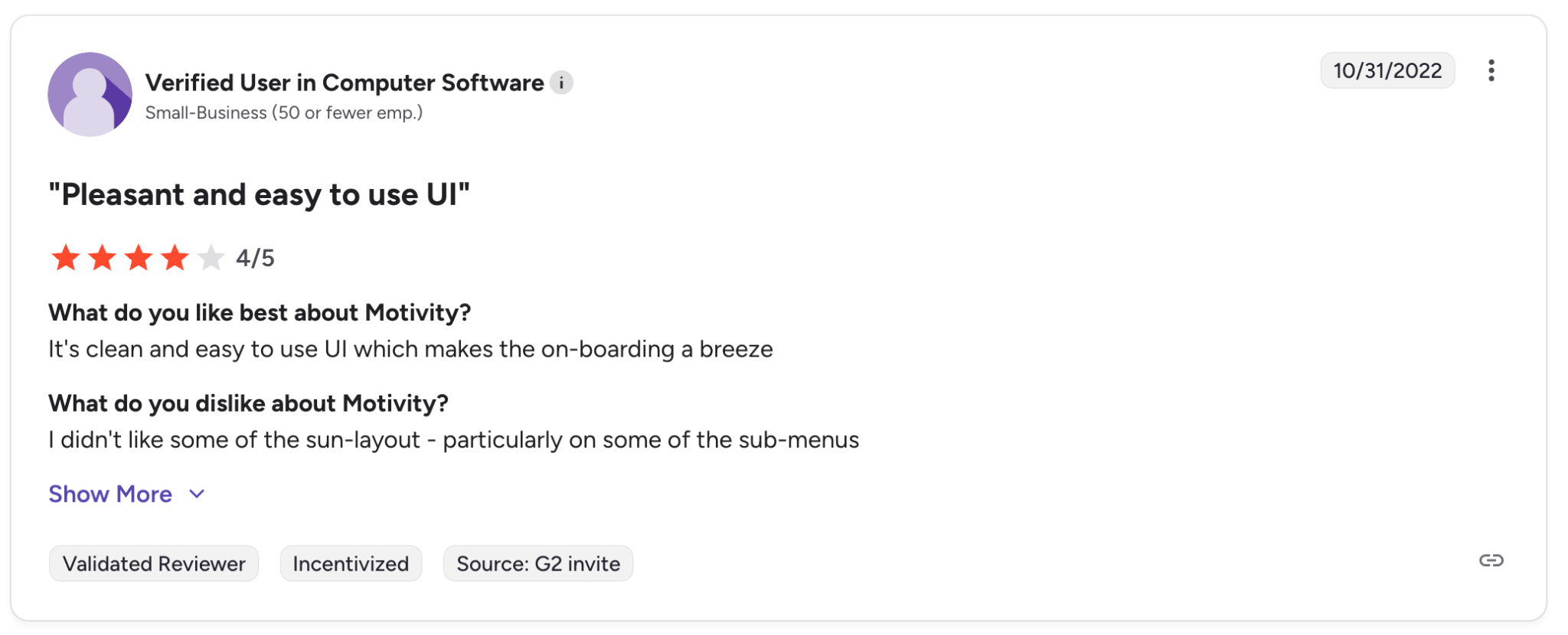
“Good UI, easy to use and very friendly for English-speaking users.” – Verified User, G2
“It is very hard to know how to get everything set up right so that it will work correctly or the way you want it to. The system is very complex and you have to take classes to make it do right.” – Ashley C., Senior Loan Officer, G2
Pricing
From $24/learner/month for data collection or practice management, or $48/learner/month for the all-in-one platform.
Bottom line
Motivity's clinical data collection tools are its clearest strength, and it suits practices where that's the primary need. When billing and scheduling require the same depth, the gaps typically push teams toward a separate integration, like Aloha ABA, which brings its own reliability issues.
5. Theralytics: Best for solo BCBAs and start-up practices
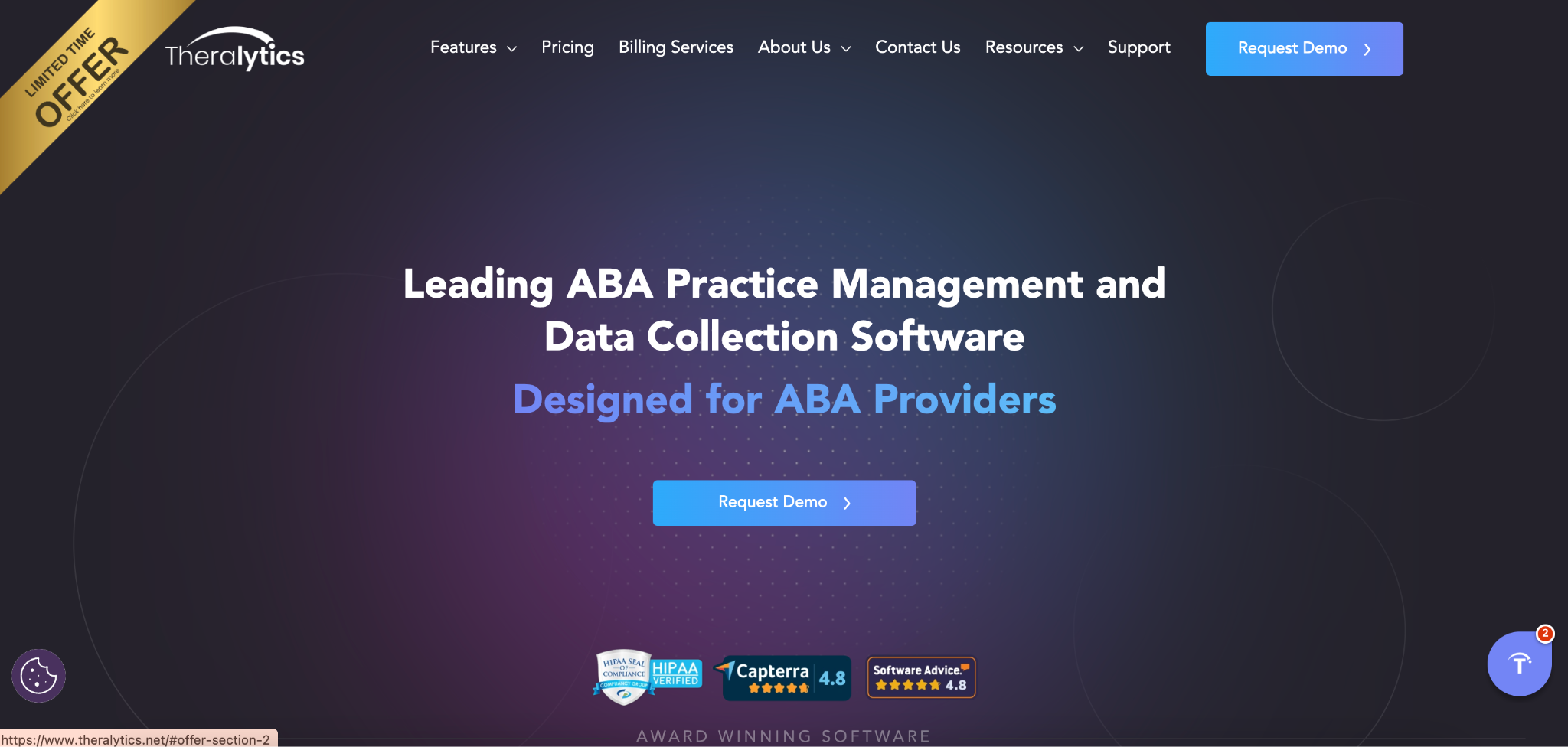
What it is: A practice management platform covering scheduling, billing, payroll, and data collection for ABA practices.
Best for: Solo BCBAs or new ABA practices with light session volume, especially those looking for a low-cost entry point.
Theralytics is quick to set up and straightforward to navigate at a basic level. The main limitation flagged consistently in user reviews is reliability: notes failing to save mid-session is a recurring complaint. Users also report having to track compliance outside the platform.
Key features
- Scheduling, billing, and payroll
- Business analytics dashboards
- Eligibility checks and automated billing reminders
Pros
✅ Fast to set up, low barrier to entry for new practices
✅ Covers core scheduling, billing, and data collection in one place
Cons
❌ Session notes not saving is a common complaint.
❌ There’s limited billing customization for specific payors.
❌ Compliance tracking lacks the depth most growing practices need.
❌ It’s not built to scale as caseloads and teams grow.
What users say
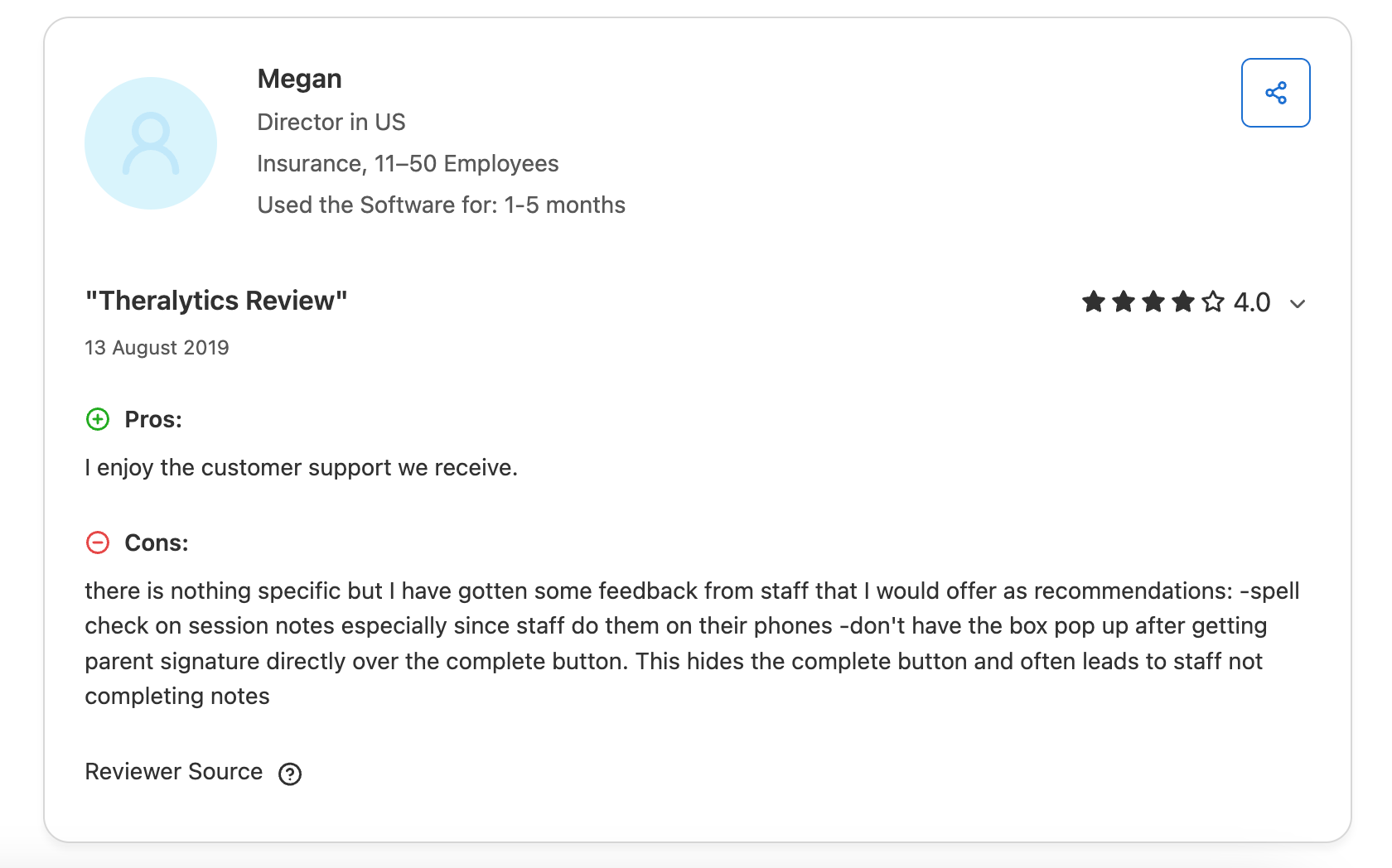
“Overall experience is great, still learning all the features, would like more explanation/videos on how to use certain features” – Jaclyne, Administrative Coordinator, Capterra
“Therapytics often has glitches, and appointments get deleted.” – Jessica, CEO in US, Capterra
Pricing
Practice management is $20/client/month or $30/user/month. The combined practice management and data collection package is $30/client/month or $45/user/month. A free BCBA Startup Package covers the first 6 months. A minimum monthly fee of $200 or $300 applies, depending on the package.
Bottom line
Theralytics is a workable starting point for a solo BCBA or new practice with minimal session volume. As caseloads grow and team size increases, its reliability and compliance limitations become harder to work around.
Which EHR software should you choose?
The right EHR for your private practice depends on your size, the complexity of your billing, and how well-connected you need clinical and admin workflows to be.
Choose Raven Health if you:
- Run a small ABA practice
- Want core EHR functionality without a lengthy setup or heavy training
Choose RethinkBH if you:
- Need clinical programming tools and staff development resources in the same system
- Are comfortable with a modular structure
Choose Ensora Health if you:
- Offer mental health, physical, speech, or occupational therapy
- Want published pricing and a free trial before committing
- Don't need ABA-specific session data collection or billing workflows
Choose Motivity if you:
- Prioritize deep, highly customizable clinical data collection above everything else
- Are comfortable sourcing a separate billing solution
Choose Theralytics if you:
- Are a solo BCBA just starting out and need a low-cost entry point with minimal volume
For practices that need all of these workflows connected rather than cobbled together, there's a stronger fit.
Choose Passage Health if you:
- Run an ABA or autism therapy practice
- Need supervision tied to sessions and credentials
- Want clinical documentation and billing connected in one system
- Need reports ready for insurance reauthorizations and audits
- Want to reduce denied claims from credential mismatches or documentation gaps
Try Passage Health for your ABA private practice
Running an ABA private practice means juggling session documentation, supervision records, credentials, scheduling, and insurance claims. When these live in separate systems, errors are inevitable.
Passage Health brings everything together in one platform built specifically for ABA therapy. Here’s some of what the platform offers:
- Mobile data collection: RBTs document session notes in real time with automatic syncing, so data is always current, and nothing needs reentering.
- Treatment reports and graphing: Progress is automatically visualized, so customizable reports are always ready for insurance reauthorizations.
- Scheduling: Set up appointments, reassign staff, and manage your full, color-coded calendar on one screen.
- Electronic billing: Generate and manage claims directly from session data, with automated coding that catches errors before submission.
- Reporting and insights: Track practice performance and utilization from a single dashboard, without having to pull data from separate tools.
Passage Health is built to grow with your practice. The platform has a simple, intuitive interface and comes with 1:1 onboarding support from a responsive team.
A quarterly release cycle means that new features are regularly added, based on customer feedback. The platform integrates with Frontera AI, so your BCBAs can access clinical AI features that support treatment planning and documentation.
Book a demo to see how Passage Health can work for your practice.
Final verdict
Most EHR platforms were built for general medical practices, then adjusted to include behavioral health as an afterthought. When this happens, ABA teams are left to work around the gaps.
Passage Health was designed specifically for ABA and autism therapy practices, with real-time session data collection, supervision tracking, and automated billing built in from the ground up. For private practices that need clinical and billing workflows connected in one place, it's the clearest frontrunner in 2026.
Frequently asked questions
What’s the best EHR for private practice?
The best EHR for private practice in ABA therapy is Passage Health. It connects clinical documentation, supervision tracking, and billing in one system, reducing errors and keeping your practice audit-ready.
What should an ABA practice look for in an EHR?
An ABA practice should look for an EHR that handles real-time data collection, links session documentation to billing automatically, and generates progress reports for insurance reauthorizations. General EHR platforms often lack these features, leaving ABA teams to fill the gaps with manual admin.
Do ABA private practices need a specialty EHR?
Yes, ABA private practices need a specialty EHR because general platforms lack behavioral data collection, program tracking, and ABA-specific billing workflows. A purpose-built platform handles these features, freeing up time for direct care.
Can a small ABA practice afford a specialty EHR?
Yes, small ABA practices can afford specialty EHRs because platforms like Passage Health customize pricing based on practice size. The cost is typically offset by the time saved when fewer claims are denied, and teams aren’t entering data in different, disconnected tools.
References
Ensora Health. (n.d.). Retrieved from https://ensorahealth.com/
Motivity. (n.d.). Retrieved from https://www.motivity.net/
Raven Health. (n.d.). Retrieved from https://ravenhealth.com/
Rethink Behavioral Health. (n.d.). Retrieved from https://www.rethinkbehavioralhealth.com/
Theralytics. (n.d.). Retrieved from https://www.theralytics.net/
